By
By
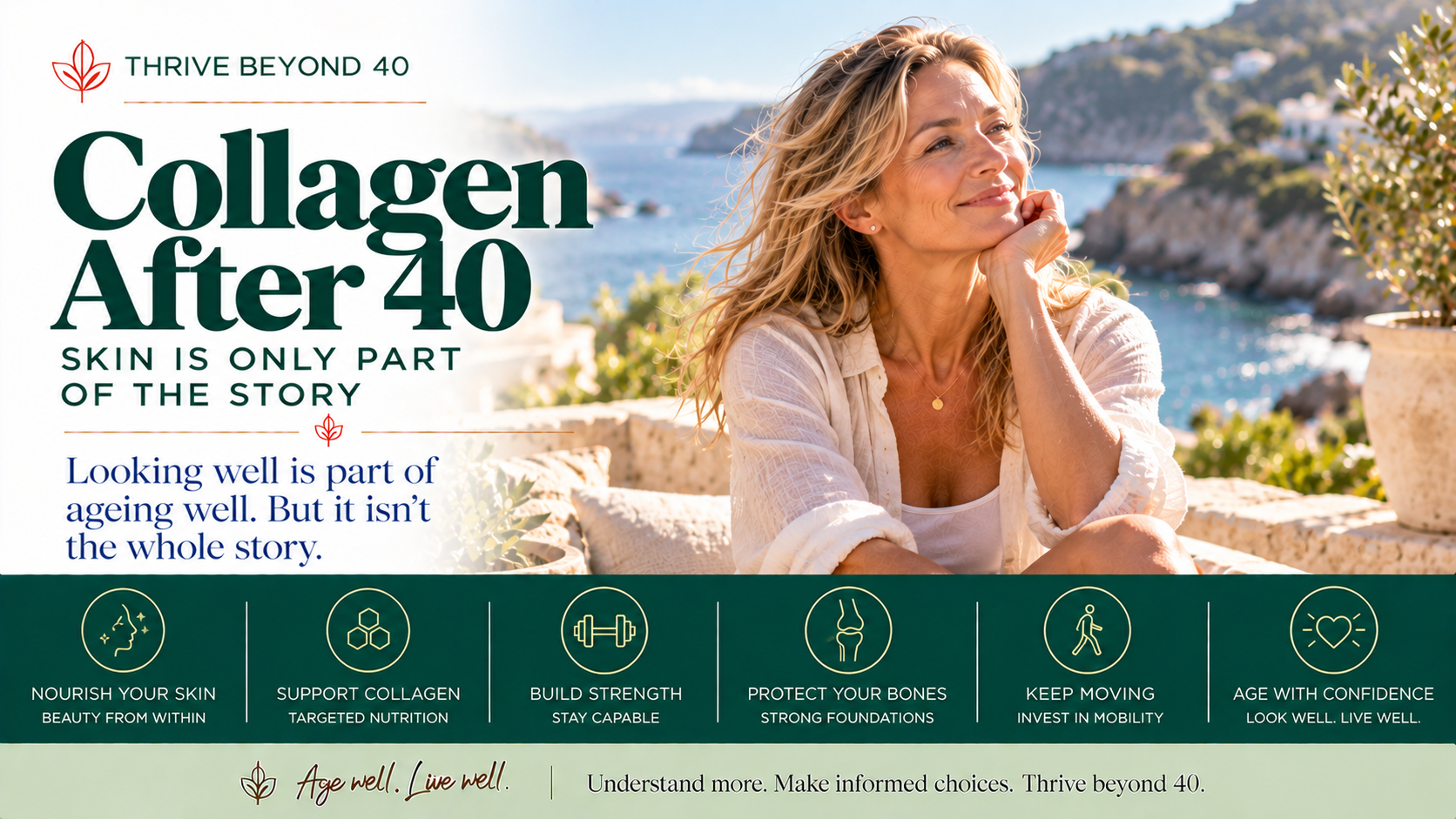
Looking well is part of ageing well. But it isn't the whole story.
Mention collagen and most people immediately think of one thing.
Skin.
Fine lines.
Wrinkles.
Elasticity.
Perhaps hair and nails.
And that's understandable.
Collagen has become one of the biggest conversations in beauty and healthy ageing.
But collagen isn't simply something that helps our skin look good.
It's a structural protein found throughout the body.
Skin.
Bones.
Tendons.
Ligaments.
Cartilage.
Connective tissues.
The structures that help hold us together and allow us to move.
So while I'm absolutely interested in collagen from a beauty perspective, particularly as we move through our 40s and beyond, I think the conversation deserves to be bigger.
Because looking well matters.
But so does moving well.
And when we're thinking about healthy ageing, those two things don't have to compete.
Collagen is part of your body's structure
Collagen is the most abundant protein in the human body.
Think of it as part of the structural framework supporting many of our tissues.
Different types of collagen occur in different parts of the body.
Type I collagen is particularly abundant and is found in tissues including skin, bone and tendons.
Type III collagen is also found in skin and other connective tissues and commonly occurs alongside Type I.
There are many other collagen types too.
So collagen isn't a single beauty ingredient sitting somewhere beneath the skin.
It's part of the architecture of your body.
That's why I think it deserves a place in the healthy-ageing conversation.
What happens to collagen after 40?
Our collagen doesn't remain unchanged throughout life.
Collagen production and turnover change as we age.
Over time, these changes can become visible in the skin.
Perhaps it feels drier.
Less firm.
Less elastic.
Fine lines become more noticeable.
Skin doesn't seem to "bounce back" in quite the same way.
But what we're seeing on the outside is only one part of a much broader biological ageing process.
Collagen changes with age because we change with age.
That isn't something we need to fear.
But it is something we can understand and support.
For women, menopause adds another dimension
Women can experience particularly noticeable changes in skin around menopause.
Oestrogen influences skin physiology, including collagen.
As oestrogen levels decline through the menopausal transition, changes can occur in skin thickness, hydration, elasticity and collagen.
For many women, this can feel surprisingly sudden.
You look in the mirror one day and think:
"When did that happen?"
At the same time, you may be dealing with changing body composition, disrupted sleep, brain fog, hot flushes and everything else that can accompany perimenopause.
It's easy to see these changes purely as signs of getting older.
I prefer a different perspective.
Perimenopause can be a prompt to start investing more intentionally in yourself.
Not because you're trying to stop ageing.
Because you have many years ahead worth looking and feeling well for.
It's okay to want to look good
I think healthy-ageing conversations sometimes become unnecessarily apologetic about beauty.
As though caring about your skin is superficial.
It isn't.
You can care about your heart health and your skin.
Your bone density and your hair.
Your muscle strength and your appearance.
Your longevity and how you feel when you look in the mirror.
These things aren't mutually exclusive.
Looking well can be part of feeling well.
The important distinction is that healthy ageing isn't about desperately trying to look 25 forever.
It's about supporting the body you're living in now.
And feeling confident in it.
Beautiful skin starts from within
Skin care matters.
Cleansing.
Moisturising.
Sun protection.
Appropriate topical ingredients.
They all have a place.
But your skin is also living tissue.
It requires nutrition.
Protein provides amino acids.
Vitamin C contributes to normal collagen formation for the normal function of skin.
Essential fatty acids form part of cell membranes.
Micronutrients support normal physiological processes.
Water contributes to normal hydration.
And your overall dietary pattern matters.
What you put on your skin is only part of the picture.
What you give your body matters too.
Protein provides building materials
Collagen is a protein.
And one of the most basic nutritional foundations for healthy ageing is ensuring you're eating adequate protein overall.
Protein isn't only relevant if you're trying to build muscle.
It contributes to the growth and maintenance of muscle mass and the maintenance of normal bones.
That's particularly important after 40, when we're increasingly thinking about:
Muscle.
Strength.
Recovery.
Bone health.
Physical capability.
And healthy body composition.
So before becoming obsessed with one collagen product, look at your broader nutritional foundation.
Are you eating enough protein?
That's a useful question.
Then targeted collagen nutrition can add another layer
This is where collagen peptides become interesting.
Hydrolysed collagen has been broken down into smaller peptides, making it easier to incorporate into nutritional products.
Research into oral collagen supplementation continues to evolve, but studies have reported benefits in areas including skin hydration and elasticity with certain hydrolysed collagen preparations.
The details matter.
The formulation.
The amount.
How consistently it's taken.
The study population.
The outcomes being measured.
That's why I don't believe every product with the word collagen on the label should automatically be treated as equivalent.
Look beyond the front of the packet.
The collagen we use provides Types I and III
Within the Thrive Beyond 40 Collagen Renewal Program, we use a liquid marine collagen formulation providing 8 grams of hydrolysed fish collagen per daily 50 mL serving.
The collagen provides Types I and III.
That makes sense to me because these collagen types are relevant to the structural tissues we're discussing, including skin and connective tissues.
But the formulation doesn't stop with collagen alone.
It also provides complementary nutrients designed to support a broader beauty and healthy-ageing approach.
Vitamin C matters because your body makes collagen
Taking collagen isn't the only part of the collagen conversation.
Your body also needs nutrients involved in its own normal collagen formation.
Vitamin C is particularly important.
It contributes to normal collagen formation for the normal function of:
Skin
Bones
Cartilage
That makes vitamin C much more interesting than simply thinking of it as an "immune vitamin".
It belongs in our conversation about structure.
Again, healthy ageing is interconnected.
Skin is only part of the story.
Hydration deserves attention too
One of the most noticeable skin changes with age can be dryness.
That's where another ingredient in our collagen formulation becomes relevant.
Hyaluronic acid.
Hyaluronic acid occurs naturally in the body and is known for its ability to bind water.
Our Collagen Renewal formulation provides hyaluronic acid alongside marine collagen peptides and complementary nutrients.
But hydration isn't simply something you drink in a collagen shot.
Your broader habits still matter.
Adequate fluids.
A nourishing diet.
Skin care.
Sun protection.
Sleep.
Not smoking.
Targeted nutrition works best when the foundations are there too.
Collagen and gut nutrition can overlap
This is something people may not expect from a collagen product.
The formulation we use also includes chicory root fibre, a source of inulin.
Inulin is a prebiotic fibre that can be fermented by bacteria in the large intestine.
Does that make a collagen product a complete gut-health solution?
No.
Your gut still needs a varied, fibre-rich dietary pattern.
Vegetables.
Fruit.
Wholegrains.
Legumes.
Nuts.
Seeds.
Different plants.
Different fibres.
But I like the fact that the formulation acknowledges something we talk about repeatedly at Thrive Beyond 40:
The body isn't a collection of isolated systems.
Nutrition overlaps.
Collagen isn't only about your face
This is where the conversation becomes much more interesting to me.
Collagen is found in connective tissues throughout the body.
And as we age, we increasingly care about what our body can do, not simply how it looks.
Can I walk comfortably?
Can I train?
Can I travel?
Can I climb stairs?
Can I keep lifting weights?
Can I stay active?
Can I keep doing the things I enjoy?
That's why collagen sits naturally beside another major healthy-ageing priority.
Strength.
Muscle and collagen aren't the same thing
This distinction matters.
If your goal is maintaining muscle, collagen doesn't replace a complete protein-rich diet or resistance training.
You still need to challenge your muscles.
And you still need adequate overall protein.
The Collagen Boozt X formulation we use provides 9.9 grams of protein per 50 mL serving, alongside its 8 grams of hydrolysed marine collagen.
Protein contributes to the growth and maintenance of muscle mass.
But the bigger strategy remains:
Strength training + adequate nutrition + recovery.
Collagen fits into that picture.
It doesn't replace it.
Your bones deserve attention too
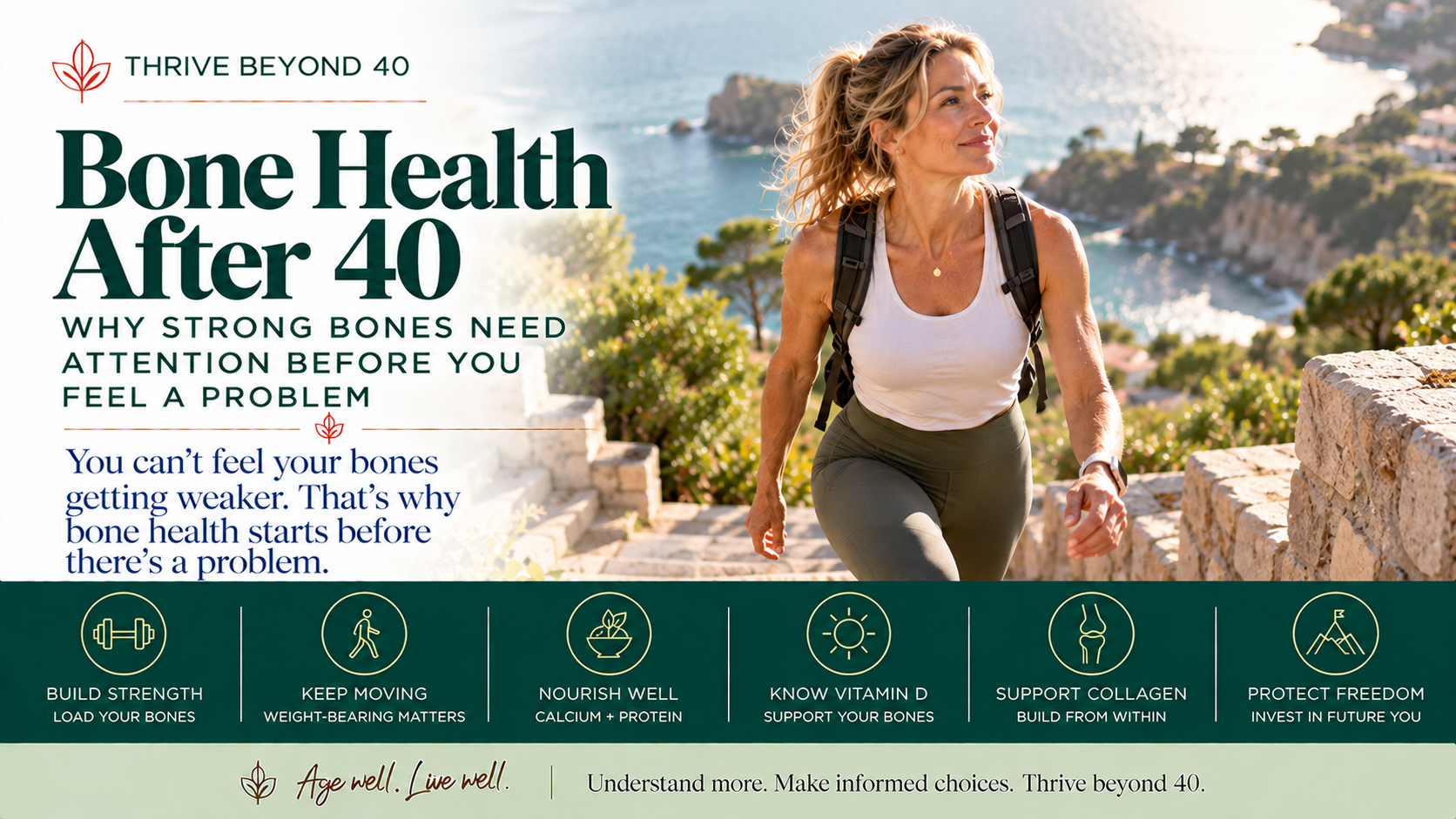
We've now explored this in our dedicated article on Bone Health After 40, and collagen is relevant there as well.
Bone isn't simply a block of calcium.
It contains an organic matrix rich in collagen that provides structural framework for mineralisation.
That doesn't mean taking collagen treats osteoporosis.
It doesn't.
Bone health still depends on a much broader picture including:
Resistance and weight-bearing exercise.
Adequate calcium.
Vitamin D.
Protein.
Hormonal and medical factors.
Smoking.
Alcohol.
Individual risk.
But it helps explain why I don't think collagen belongs solely in the beauty aisle.
We're supporting a body, not just a complexion.
Movement is one of the best healthy-ageing strategies we have
If you're investing in collagen because you want to age well, invest in movement too.
Walk.
Lift weights.
Swim.
Hike.
Dance.
Do Pilates.
Cycle.
Garden.
Play sport.
Move your joints.
Challenge your muscles.
Use your body.
Because the goal isn't to preserve yourself perfectly.
The goal is to remain capable.
And capability requires participation.
Protect the collagen you already have
Supporting collagen isn't only about adding something.
It's also about protecting your skin and tissues from avoidable stressors.
For skin, one of the biggest is excessive ultraviolet exposure.
Australia makes this particularly relevant.
Sun protection matters.
So does avoiding smoking.
Eating well.
Getting adequate sleep.
Managing your overall health.
And being thoughtful about alcohol.
No collagen supplement can undo every lifestyle factor.
Foundations first.
Always.
Consistency matters more than a beauty blitz
Healthy ageing isn't a 30-day project.
Neither is collagen support.
Our tissues don't suddenly change because we've been exceptionally healthy since Monday.
What matters is what we do repeatedly.
The meals.
The movement.
The strength training.
The sleep.
The sun protection.
The nutritional support.
The habits we can actually sustain.
That's why I prefer simple routines.
Something you can keep doing beats something impressive you abandon after three weeks.
So, do you need collagen after 40?
I don't think healthy ageing works well when we reduce it to:
"Everyone must take this."
Collagen isn't an essential supplement for every person.
But collagen itself is fundamental to the body, and changes in collagen are a normal part of ageing.
For someone who wants to take a proactive approach to skin, beauty, connective tissue and healthy ageing, targeted collagen nutrition can be a useful addition to strong food and lifestyle foundations.
That's how I position it.
Not a miracle.
Not an anti-ageing cure.
A considered nutritional tool within a much bigger healthy-ageing strategy.
Looking well and ageing well can coexist
I don't want healthy ageing to become a conversation entirely about preventing disease.
I want us to talk about:
Strength.
Travel.
Skin.
Energy.
Confidence.
Movement.
Style.
Food.
Friendships.
Adventure.
Beauty.
Health.
Because we're not simply trying to accumulate years.
We're trying to enjoy ourselves while we're here.
So yes.
Look after your skin.
Support your collagen.
Build muscle.
Protect your bones.
Move your body.
Eat nourishing food.
Wear the sunscreen.
Sleep.
Travel.
Dress beautifully.
Laugh.
Go somewhere.
Use the body you're investing in.
Because collagen after 40 isn't only about trying to look younger.
It's about supporting the way you want to age.
Look well.
Move well.
Age well.
Health is the foundation. Life is the point.
Age Well. Live Well.
Ready to invest in the way you age?
Look well. Move well. Age well.
The Thrive Beyond 40 Collagen Renewal Program combines targeted marine collagen nutrition with a broader approach to beauty, movement, strength and healthy ageing.
Because skin is part of the story.
But it isn't the whole story.
Continue exploring
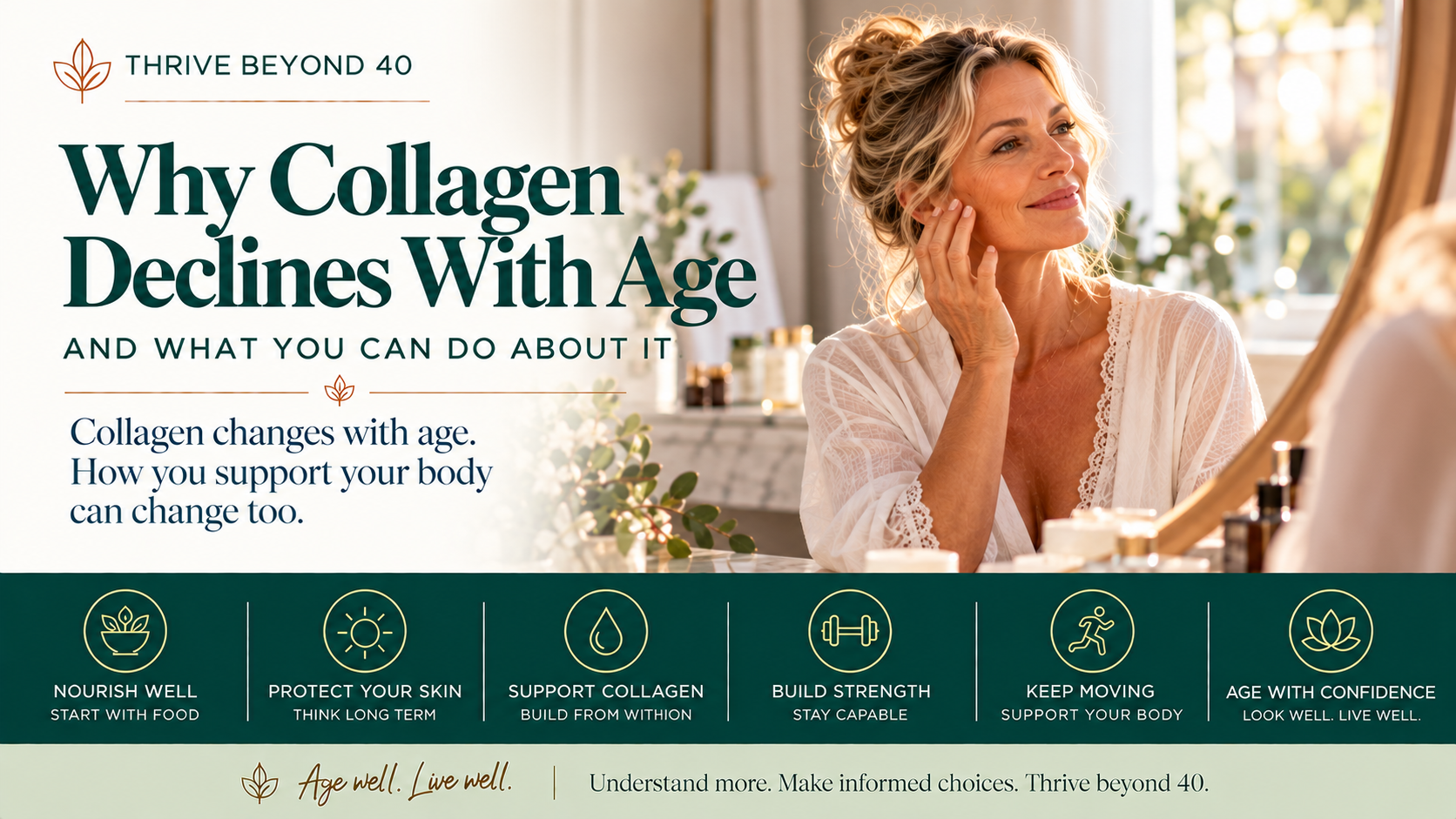
Why Collagen Declines With Age and What You Can Do About It →
Bone Health After 40: Why Strong Bones Need Attention Before You Feel a Problem →
Strength After 40: Why Muscle Is One of Your Best Investments in Healthy Ageing →
Keywords: collagen after 40, collagen for women over 40, marine collagen, Type I collagen, Type III collagen, collagen and perimenopause, collagen and bone health, collagen and connective tissue
Category: Skin, Collagen & Beauty