By
By
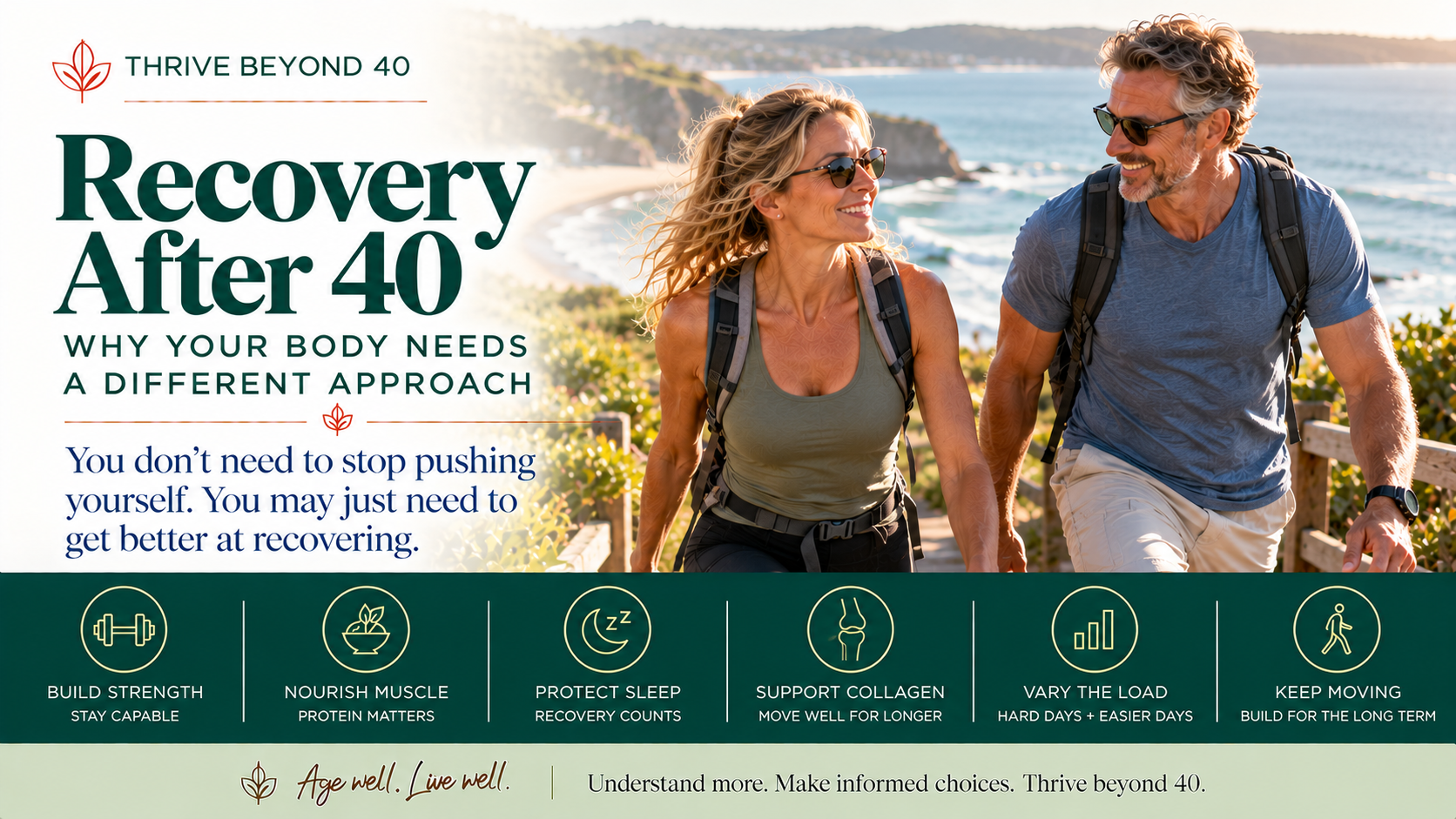
You don't need to stop pushing yourself. You may just need to get better at recovering.
Remember when you could do a hard workout, stay up too late, get five hours of sleep and somehow wake up ready to do it all again?
Your body may have other ideas now.
Perhaps a big training session stays with you for longer.
You feel sorer after exercise.
A late night takes two days to recover from instead of one.
An injury seems to linger.
Stress feels more physically draining.
Or you've simply noticed that your body doesn't bounce back quite as quickly as it once did.
That doesn't mean you should stop challenging yourself.
Quite the opposite.
Staying strong and active becomes increasingly important as we age.
But the equation changes.
Training matters.
Nutrition matters.
And recovery matters too.
The goal isn't to do less with your life.
It's to build a body capable of doing more of it for longer.
Recovery isn't the opposite of progress
We tend to celebrate effort.
The workout.
The kilometres.
The weights.
The early morning.
The personal best.
The discipline.
Recovery isn't nearly as exciting to post about.
But exercise itself is only part of the process.
Training creates a stimulus.
Your body then needs the opportunity and resources to adapt to it.
That's where recovery comes in.
The work creates the challenge.
Recovery helps you become ready for the next one.
If you continually ask more from your body without giving enough back, eventually something can give.
Performance.
Energy.
Motivation.
Sleep.
Or your enthusiasm for exercise altogether.
After 40, the goal changes
In your 20s, exercise might have been mostly about appearance.
Or sport.
Or burning calories.
Or seeing how hard you could push yourself.
After 40, I think there's a much more interesting goal available.
Capability.
Being strong enough to carry your own luggage.
Fit enough to explore a city on foot.
Mobile enough to get down onto the floor and back up.
Confident enough to try something new.
Strong enough to protect your independence.
Energetic enough to say yes to life.
Exercise stops being something we do simply to change our body.
It becomes something we do to protect what our body can do.
And when capability becomes the goal, recovery starts to make much more sense.
Muscle deserves your attention
From midlife onwards, maintaining muscle becomes increasingly important.
Age-related loss of muscle mass and strength can gradually affect physical capability, balance and independence.
That doesn't mean decline is inevitable.
It means muscle needs a reason to stay.
Resistance training provides that reason.
Weights.
Machines.
Resistance bands.
Body-weight exercises.
Whatever works for you.
You don't have to become a bodybuilder.
You don't have to train six days a week.
But regularly asking your muscles to work against resistance is one of the most valuable investments you can make in your future physical capability.
Then comes the other half of the equation.
Give those muscles what they need to recover.
Protein matters more than simply counting calories
When people want to change their body composition, the conversation often starts with eating less.
After 40, I think we also need to ask:
Am I eating enough of the things my body needs?
Protein provides amino acids used to build and maintain body tissues, including muscle.
If you're strength training, staying active or trying to preserve lean mass while losing body fat, adequate protein deserves attention.
That might mean including a meaningful source of protein at each meal rather than leaving most of it until dinner.
Eggs.
Fish.
Greek yoghurt.
Cottage cheese.
Chicken.
Lean meat.
Tofu.
Legumes.
Whatever suits the way you eat.
The point isn't to turn every meal into a calculation.
Nourish the body you're asking to perform.
Don't forget carbohydrates
Carbohydrates sometimes get treated as though they're incompatible with healthy ageing.
They aren't.
Carbohydrate is an important fuel source, particularly for physical activity.
Wholegrains.
Fruit.
Legumes.
Potatoes.
Rice.
Oats.
Other minimally processed carbohydrate-rich foods.
If you're active, constantly restricting fuel while expecting your body to perform and recover brilliantly doesn't make much sense.
Food isn't simply something to control.
Food is also fuel and building material.
Hydration is simple, but it matters
This won't sound revolutionary.
Drink enough fluid.
Your needs vary with temperature, activity, sweat rate and individual circumstances.
And here in Australia, exercising outdoors can make hydration particularly relevant.
You don't need to turn drinking water into another optimisation project.
But consistently reaching the end of the day dehydrated isn't helping your recovery either.
Sometimes the foundations really are that simple.
Sleep is where recovery gets serious
We explored this in depth in our article on Sleep After 40, but it deserves a place here too.
Sleep supports physical and mental recovery.
And it's one of the easiest things to sacrifice when life becomes busy.
Work runs late.
You stay up because it's the only quiet part of the day.
Children wake.
Perimenopause interrupts sleep.
You train early because that's the only time available.
Then you expect your body to recover as though none of it matters.
It matters.
Training and sleep aren't competing health priorities.
They work together.
If you're consistently exhausted, adding another hard workout isn't always the healthiest answer.
Sometimes recovery is the training decision.
Perimenopause can change the recovery equation
For women, midlife can bring another variable.
Perimenopause.
Changing hormone levels can coincide with changes in sleep, body composition, muscle and bone health, temperature regulation, mood and energy.
That doesn't mean women become fragile during perimenopause.
Far from it.
Strength training and physical activity remain enormously valuable.
But it does mean the strategy may need to become smarter.
If sleep is poor, recovery may need more attention.
If you've never strength trained, this is a brilliant time to start.
If you're constantly dieting, reconsider whether you're adequately fuelling your body.
If something hurts persistently, don't simply keep training through it because that's what you did at 25.
Midlife isn't a reason to stop challenging your body.
It's a reason to understand it better.
Soreness isn't the measure of a good workout
There's a strange belief in fitness culture that if you're not sore the next day, the workout didn't count.
It did.
Delayed-onset muscle soreness can occur after unfamiliar or challenging exercise, but soreness isn't the goal.
Progress doesn't require spending three days struggling to sit down.
A good training program should challenge you appropriately while allowing you to return and train again.
Consistency beats repeatedly destroying yourself.
Especially if the goal is to remain active for decades.
More exercise isn't always better
This can be difficult for high achievers.
If three sessions are good, surely six are better?
If 10,000 steps are good, surely 20,000 are better?
If one hard workout works, surely another tomorrow will work faster?
Not necessarily.
Your body doesn't award bonus health points for exhaustion.
A well-rounded week might contain different types and intensities of movement.
Strength.
Walking.
Cardiovascular exercise.
Mobility.
Harder sessions.
Easier sessions.
And recovery.
The exact mix will be different for everyone.
The goal is sustainable challenge, not maximum punishment.
Active recovery still counts
Recovery doesn't necessarily mean lying on the sofa all day.
Sometimes gentle movement is exactly what feels good.
Walking.
Easy cycling.
Swimming.
Mobility work.
Stretching if it feels useful.
Gardening.
A relaxed day at the beach.
Movement can help keep you active without placing the same demand on your body as another hard training session.
And psychologically, it helps move us away from the idea that exercise only "counts" when it's difficult.
Your body benefits from movement in many forms.
Connective tissue deserves a place in the conversation
Muscle gets most of the attention in fitness.
But it isn't working alone.
Tendons connect muscle to bone.
Ligaments help stabilise joints.
Cartilage forms part of our joint structures.
Bones provide the framework.
Collagen is an important structural protein found throughout many of these tissues.
And collagen production and turnover change as we age.
This is one reason I think the healthy-ageing conversation needs to look beyond muscle alone.
We want a body that is strong, mobile and resilient.
That means thinking about the structures that help us move as well.
Where collagen nutrition fits
Food and lifestyle foundations come first.
Adequate protein.
A varied diet.
Vitamin C.
Strength and movement.
Sleep.
Appropriate recovery.
But targeted nutrition can have a place too.
Within Thrive Beyond 40, our Collagen Renewal Program uses hydrolysed marine collagen peptides alongside complementary nutrients.
The formulation we use provides Types I and III marine collagen, together with vitamin C, hyaluronic acid and other nutrients.
Vitamin C contributes to normal collagen formation for the normal function of cartilage and bones.
And protein contributes to the maintenance and growth of muscle mass and the maintenance of normal bones.
That's why I don't see collagen purely through a beauty lens.
Looking well is part of the story.
Moving well matters too.
It's also why our Collagen Renewal philosophy is:
Look well. Move well. Age well.
Collagen doesn't replace strength training
This distinction matters.
You can't drink collagen and expect it to replace resistance training.
You can't take a supplement and ignore movement.
And targeted nutrition can't compensate for chronically inadequate sleep or poor overall nutrition.
That's not how we approach health at Thrive Beyond 40.
Our philosophy is much simpler:
Food and lifestyle foundations first. Targeted nutrition where it adds value.
Collagen nutrition can sit within a broader strategy.
It isn't the strategy.
Recovery is also nervous-system recovery
Not all fatigue comes from exercise.
Sometimes the hardest thing you've done all week is think.
Deadlines.
Meetings.
Family logistics.
Caring responsibilities.
Notifications.
Financial pressure.
Decision after decision after decision.
You may not have run a marathon.
But your body can still feel exhausted.
That's why recovery isn't only about muscles.
It's also about creating periods when you aren't constantly being asked to perform.
Walking.
Reading.
Music.
Being outside.
Seeing friends.
Taking a holiday.
Doing absolutely nothing useful for an hour.
Whatever helps you genuinely shift gears.
Rest doesn't have to earn its place by improving productivity.
Sometimes you can rest because you're a human being.
Stress and exercise need context
Exercise can be an excellent way to manage stress.
But your body doesn't experience your workout in complete isolation from the rest of your life.
If you've had:
Four hours of sleep.
A stressful week.
Very little food.
A sick child.
Back-to-back meetings.
And you're feeling depleted...
...that may not be the day you need to chase a personal best.
Adjusting your training isn't weakness.
It's information-based decision making.
There will also be days when a hard workout is exactly what you need.
The skill is learning the difference.
Listen to your body, but don't become afraid of it
"Listen to your body" is good advice until it becomes:
"Never do anything uncomfortable."
Exercise should challenge you.
Muscles can feel tired.
Your heart rate increases.
You may breathe hard.
Some soreness can happen when you do something new.
That's normal.
The goal isn't to avoid physical stress.
Your body needs challenge to adapt.
The goal is to distinguish productive challenge from signals that something needs attention.
Pain that persists deserves attention
Not every ache requires an MRI.
But persistent pain shouldn't simply become part of your identity because you're over 40.
If pain is significant, worsening, associated with swelling or injury, affecting your normal activities or simply isn't settling, get appropriate professional advice.
A physiotherapist, exercise physiologist, sports physician, GP or another relevant health professional can help depending on the issue.
Don't let someone dismiss everything with:
"You're getting older."
But don't diagnose yourself from social media either.
Ageing changes bodies.
It doesn't make persistent pain meaningless.
Your recovery strategy doesn't need to be expensive
Recovery has become an industry.
Ice baths.
Compression boots.
Massage guns.
Infrared saunas.
Red-light devices.
Supplements.
Wearables.
Some people love these things.
Some may find particular tools useful.
But before spending thousands of dollars trying to optimise recovery, make sure you've covered the basics.
Are you sleeping?
Are you eating enough?
Are you getting adequate protein?
Are you hydrating?
Are you allowing easier days?
Are you managing your training load?
Are you taking persistent pain seriously?
Don't optimise the extras while ignoring the foundations.
You don't need to train like you're 25
You also don't need to exercise like you're 85.
That's an important distinction.
Your 40s, 50s and 60s can be strong decades.
You can lift heavier.
Get fitter.
Learn new sports.
Run your first race.
Climb mountains.
Travel.
Surf.
Dance.
Hike.
Change your body composition.
Build muscle.
Become more capable than you were ten years ago.
Age doesn't automatically dictate decline.
But longevity in movement requires a longer-term mindset.
Don't just ask: "What can I do today?"
Ask:
"What will help me keep doing this ten years from now?"
That's a much more interesting question.
Recovery is part of healthy ageing
The goal of healthy ageing isn't to preserve yourself in bubble wrap.
It's to use your body.
Challenge it.
Strengthen it.
Take it places.
And then give it what it needs to keep going.
Train.
Recover.
Nourish.
Sleep.
Adapt.
Repeat.
Not perfectly.
Consistently.
You don't need to stop pushing yourself.
You may just need to get better at recovering.
Because we're not building health so we can spend our lives protecting it.
We're building health so we can use it.
Look well.
Move well.
Live well.
Health is the foundation. Life is the point.
Age Well. Live Well.
Ready to support the body you want to keep using?
Look well. Move well. Age well.
The Thrive Beyond 40 Collagen Renewal Program combines targeted marine collagen nutrition with a broader approach to strength, movement, recovery and healthy ageing.
Because investing in how you age isn't only about how you look.
It's about what your body allows you to keep doing.
Continue exploring
Sleep After 40: Why Recovery Matters More Than You Think →
Collagen After 40: Skin Is Only Part of the Story →
Perimenopause and Healthy Ageing: Looking Beyond the Symptoms →
Keywords: recovery after 40, exercise recovery after 40, muscle recovery, strength after 40, protein after 40, collagen and recovery, perimenopause recovery, healthy ageing fitness
Category: Strength & Recovery