By
By
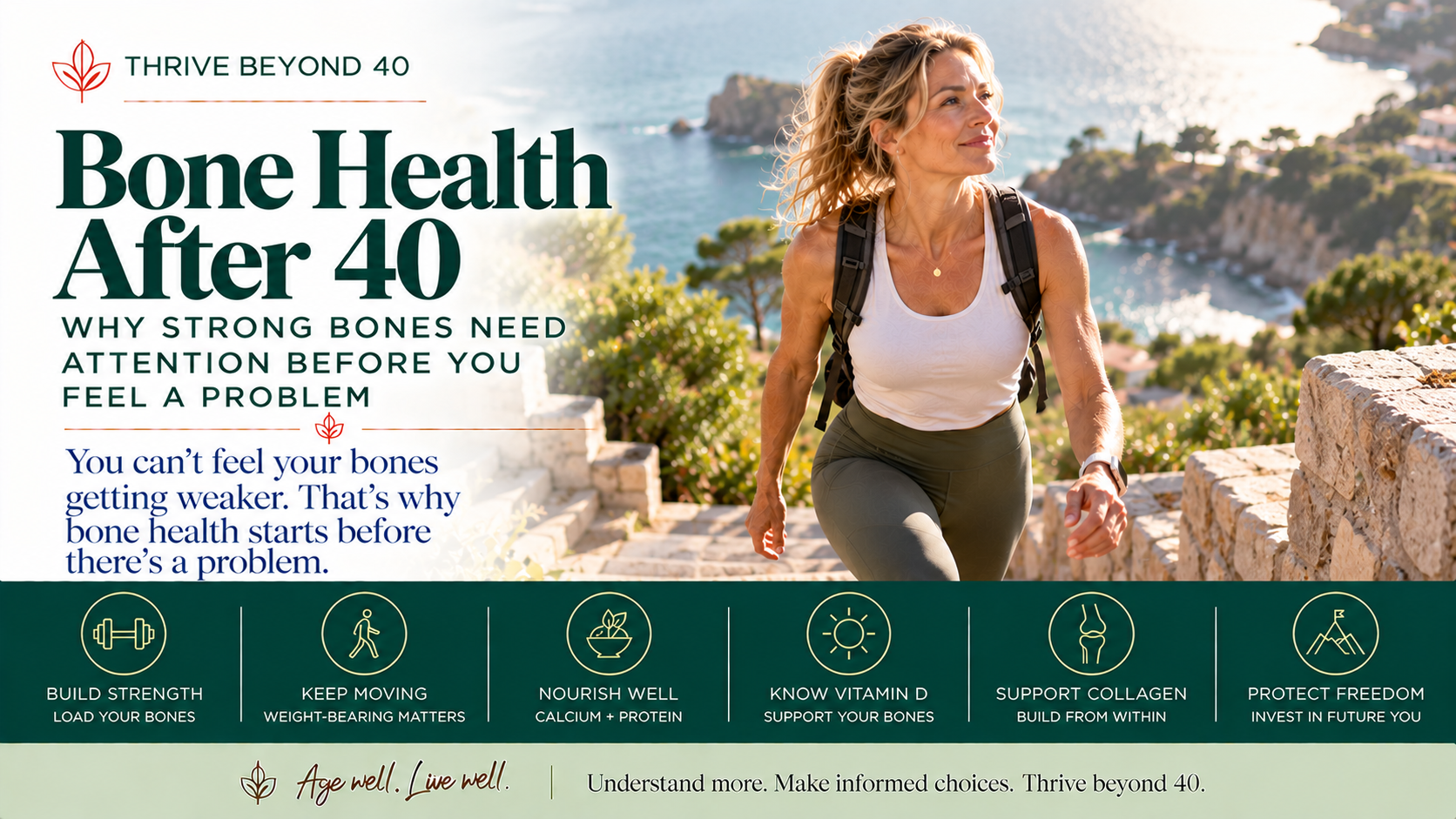
You can't feel your bones getting weaker. That's why bone health needs to start before there's a problem.
We spend a lot of time thinking about the parts of our body we can see.
Skin.
Hair.
Muscle.
Weight.
Body shape.
Bones are different.
Most of the time, we don't think about them at all.
They quietly provide the structure that allows us to stand, walk, lift, travel, exercise and move through everyday life.
And because changes in bone density generally aren't something we can feel happening, it's easy to assume everything is fine.
Until it isn't.
That's what makes bone health such an important healthy-ageing conversation.
Not because we should become frightened of getting older.
Because some of the best opportunities to support our future bones happen before we think we need to.
Your bones are living tissue
It's easy to imagine the skeleton as a fixed frame holding everything together.
But bone is living, active tissue.
Throughout life, old bone tissue is continually being broken down and new bone is being formed.
During childhood and adolescence, we're building bone rapidly.
We eventually reach peak bone mass in early adulthood.
From there, maintaining bone becomes increasingly important.
And as we age, the balance between bone formation and breakdown can shift.
Healthy bones aren't something we suddenly need at 70.
We're taking today's skeleton with us.
Why bone health becomes particularly important after 40
Bone changes occur gradually with age.
For women, menopause adds another important factor.
Oestrogen helps protect bone.
As oestrogen levels decline through the menopausal transition, bone loss can accelerate.
That's one reason I think women need to hear about bone health during perimenopause, not years after it.
You may feel perfectly healthy.
You may be exercising.
You may have no pain.
And none of those things necessarily tells you what your bone density looks like.
Bone loss can be silent.
That's precisely why prevention matters.
Osteoporosis isn't simply an "older person's problem"
Osteoporosis occurs when bones become less dense and their structure changes, increasing the risk of fracture.
We often associate it with very elderly women.
But the foundations begin much earlier.
Age matters.
So does family history.
Menopause.
Certain medical conditions.
Some medications.
Smoking.
Alcohol.
Nutrition.
Physical activity.
Low body weight in some circumstances.
And previous fractures can be relevant too.
Men aren't exempt either.
Osteoporosis affects men as well as women, particularly as they get older.
The goal isn't to look at that list and become anxious.
It's to understand your own risk.
Perimenopause is a bone-health opportunity
We've already talked about perimenopause as a broader healthy-ageing transition.
Bone health is one of the clearest examples of why.
When periods are changing and symptoms are demanding attention, bones probably aren't the first thing on your mind.
But this can be an excellent time to ask:
Am I doing resistance training?
Am I getting enough calcium?
What is my vitamin D status?
Am I eating enough protein?
Do I have osteoporosis risk factors?
Should I discuss my bone health with my GP?
That's a very different conversation from simply managing hot flushes.
It's thinking about the woman you'll be 20 years from now.
Strength training is also bone training
The article we just published on Strength After 40 focused heavily on maintaining muscle and physical capability.
But resistance training has another important role.
Bones respond to load too.
When muscles pull against bones during resistance exercise, the skeleton experiences mechanical loading.
Appropriately designed resistance and weight-bearing exercise can help support bone health.
Weights.
Machines.
Body-weight exercises.
Impact activities where appropriate.
Walking and other weight-bearing movement.
The right exercise will depend on your individual health, fitness and bone status.
If you've already been diagnosed with osteoporosis or have significant risk factors, exercise may need to be individually tailored.
But the overarching message is wonderfully simple:
Your skeleton was designed to be used.
Walking is wonderful, but strength deserves a place too
I love walking.
It's accessible.
It's social.
It's excellent for cardiovascular health.
It gets us outside.
And it's something many people can continue doing throughout life.
But if your entire healthy-ageing exercise strategy is walking, consider adding some resistance training.
Muscles need challenge.
Bones benefit from appropriate loading.
Balance needs practice.
Capability needs maintaining.
This doesn't mean replacing your walk.
It means building a more complete movement strategy.
Walk.
Lift.
Move.
Balance.
Recover.
Protein isn't only a muscle conversation
We talked extensively about protein in our strength and recovery articles.
But protein is also relevant to the broader musculoskeletal system.
Bone isn't simply calcium.
Its structure includes a protein matrix, largely made from collagen, onto which minerals are deposited.
That's another reason extremely restrictive eating isn't necessarily compatible with healthy ageing.
Your body needs raw materials.
Protein.
Minerals.
Vitamins.
Energy.
Nourish the structure you're trying to protect.
Calcium matters, but food comes first
Calcium is probably the nutrient most people immediately associate with bones.
And for good reason.
Calcium is important for maintaining normal bones.
But you don't automatically need to start taking a high-dose calcium supplement because you've turned 40.
Start by looking at your diet.
Depending on how you eat, calcium-rich foods can include:
Dairy milk.
Yoghurt.
Cheese.
Calcium-fortified plant milks.
Certain fish eaten with the bones.
Tofu set with calcium.
Some leafy green vegetables.
Other calcium-rich or fortified foods.
Your individual requirements and whether supplementation is appropriate depend on your diet and health circumstances.
More isn't automatically better.
Understand what you're actually getting first.
Vitamin D deserves attention too
Vitamin D helps with calcium absorption and plays an important role in maintaining normal bones.
Our bodies can produce vitamin D through sun exposure, but vitamin D status varies considerably between individuals.
Lifestyle.
Skin pigmentation.
Sun exposure.
Clothing.
Season.
Location.
Age.
And other factors can influence it.
In Australia, "we get plenty of sunshine" doesn't automatically mean every person has adequate vitamin D.
If you're concerned about your vitamin D status or have risk factors for deficiency, discuss it with your healthcare professional.
Again, the principle is:
Understand before automatically supplementing.
Collagen is part of the bone story
This is where the bone-health conversation becomes particularly interesting for Thrive Beyond 40.
When most people hear collagen, they think:
Skin.
Wrinkles.
Beauty.
But collagen isn't confined to your face.
Type I collagen is a major structural protein in bone and is also found throughout connective tissues.
Bone contains a collagen-rich matrix that provides a framework for mineralisation.
That's why our approach to collagen has never been purely cosmetic.
Skin is only part of the story.
Where targeted collagen nutrition fits
Our Collagen Renewal Program uses hydrolysed marine collagen peptides, including Types I and III collagen, together with complementary nutrients.
The formulation also provides vitamin C.
Vitamin C contributes to normal collagen formation for the normal function of bones and cartilage.
It also contains protein, which contributes to the maintenance of normal bones and the growth and maintenance of muscle mass.
That makes collagen nutrition relevant to our broader philosophy of:
Look well. Move well. Age well.
But targeted collagen nutrition still sits alongside the foundations.
It doesn't replace strength training.
It doesn't replace adequate calcium.
It doesn't replace appropriate vitamin D.
And it certainly doesn't treat osteoporosis.
Food and lifestyle foundations first. Targeted nutrition where it adds value.
That's the Thrive Beyond 40 approach.
Muscle and bone are partners
This is something I want more people to understand.
We often talk about muscle health and bone health as though they're completely separate topics.
Functionally, they work together.
Muscles generate force.
Bones provide structure.
Tendons connect muscle to bone.
Joints allow movement.
Your nervous system coordinates the whole thing.
If we want to remain physically capable as we age, we need to think about the musculoskeletal system, not individual parts in isolation.
Strong muscle supports movement.
Strong bones support the structure.
Together, they help protect capability.
Balance matters more as we age too
Preventing fractures isn't only about improving bone strength.
It's also about reducing the likelihood of falling.
That's where:
Strength.
Balance.
Coordination.
Vision.
Footwear.
Medication review.
Home environment.
And general physical capability can matter.
Again, healthy ageing is interconnected.
A stronger body may help you react more effectively if you lose your balance.
Good vision may help you see the obstacle.
Appropriate footwear may help prevent the slip.
Bone strength may influence what happens if you do fall.
The body works as a system.
That's why our approach should too.
Very low weight isn't necessarily the healthy-ageing goal
For decades, women have been encouraged to make themselves smaller.
Smaller waist.
Smaller thighs.
Smaller number on the scales.
But healthy ageing requires a more sophisticated conversation.
Very low body weight can be a risk factor for poorer bone health in some people.
Aggressive dieting can also make it harder to obtain adequate protein, calcium and other nutrients.
And rapid weight loss can involve loss of lean tissue.
If you're working towards healthy fat loss, that's completely compatible with healthy ageing.
But the goal shouldn't simply be:
Become as light as possible.
Protect muscle.
Nourish bone.
Build strength.
Think about body composition rather than only body weight.
Future you needs structure.
Smoking and alcohol belong in this conversation too
Bone health isn't only about calcium tablets and exercise.
Smoking is associated with poorer bone health and fracture risk.
Higher alcohol intake can also affect bone health and increase falls risk.
You don't need to live perfectly.
But if we're going to talk seriously about protecting bones, the major lifestyle factors deserve more attention than the latest wellness hack.
Foundations first.
Always.
Should you have a bone-density scan?
Not everyone in their 40s needs a bone-density scan simply because they're getting older.
Bone mineral density testing is generally recommended according to age, medical history and individual risk factors.
But there are circumstances where earlier assessment may be appropriate.
That's a conversation for your GP.
Risk factors can include things such as previous low-trauma fractures, early menopause, family history, certain medications or medical conditions and other individual circumstances.
If you're concerned, ask.
You don't need to diagnose your own bones.
You need to understand whether assessment is appropriate for you.
Don't wait for a fracture to become interested in bone health
This is the part I keep coming back to.
We are remarkably proactive about some things.
We service our cars.
Contribute to superannuation.
Maintain our homes.
Protect our skin from the sun.
But sometimes we wait until our body gives us a problem before becoming interested in maintaining it.
Bone health challenges that mindset because bone loss can occur without obvious symptoms.
You may not get a warning.
Prevention means acting while things are still going well.
Think about the skeleton you want at 70
Imagine yourself later.
You're travelling.
Walking.
Gardening.
Playing with grandchildren.
Going to restaurants.
Carrying groceries.
Exploring cities.
Climbing stairs.
Getting on and off the floor.
Living independently.
Your bones aren't the point of that picture.
Your life is.
But your skeleton is part of the infrastructure that makes it possible.
That's what healthy ageing means to me.
We're not strengthening bones so we can admire our bone density.
We're strengthening the foundations that support the life we want to keep living.
Start building now
You don't need to become obsessed with bone health.
Start with the fundamentals.
Build strength.
Include weight-bearing movement.
Eat enough protein.
Get adequate calcium from food where possible.
Pay attention to vitamin D.
Don't smoke.
Be thoughtful about alcohol.
Maintain balance and physical capability.
Understand your individual risk factors.
Talk to your GP when assessment is appropriate.
And use targeted nutritional support where it genuinely adds value.
You can't feel your bones getting stronger every day.
But that doesn't mean the investment isn't happening.
Strong bones give future you more options.
And options are what healthy ageing is really about.
Build strength.
Protect your bones.
Keep moving.
Keep living.
Health is the foundation. Life is the point.
Age Well. Live Well.
Ready to invest in stronger foundations?
Look well. Move well. Age well.
Thrive Beyond 40 takes a broader approach to collagen, strength and healthy ageing.
Our Collagen Renewal Program combines targeted marine collagen nutrition with the foundations that matter: movement, strength, nutrition and recovery.
Because healthy ageing isn't only about what you see in the mirror.
It's about building a body that keeps supporting your life.
Continue exploring
Strength After 40: Why Muscle Is One of Your Best Investments in Healthy Ageing →
Collagen After 40: Skin Is Only Part of the Story →
Perimenopause and Healthy Ageing: Looking Beyond the Symptoms →
Keywords: bone health after 40, strong bones after 40, menopause bone health, perimenopause bone health, bone density after 40, strength training bone health, calcium after 40, vitamin D bone health, osteoporosis prevention
Category: Strength & Recovery