By
By

Your gut does more than digest food.
For a long time, gut health was mostly something we talked about when something wasn't quite right.
Bloating.
Constipation.
Feeling uncomfortable after meals.
A stomach that suddenly seemed less forgiving than it used to be.
But our understanding of the gut has become much more interesting than that.
Inside your digestive system lives an extraordinary community of microorganisms collectively known as the gut microbiome.
And while we're still learning just how complex this ecosystem is, one thing is becoming increasingly clear:
Looking after your gut is about much more than digestion.
The foods we eat, particularly the different types of fibre in our diet, help shape the environment in which our gut bacteria live.
And after 40, when we're already becoming more intentional about things like strength, heart health, hormones, sleep and healthy ageing, our gut deserves a place in that conversation too.
So, what actually is the gut microbiome?
Your digestive tract is home to trillions of microorganisms, including a huge variety of bacteria.
Together, this community is known as the gut microbiome.
It isn't something we can see.
And most of us probably don't think about it while we're eating breakfast.
But every day, the food we eat interacts with this ecosystem.
Some parts of our food are digested and absorbed earlier in the digestive tract.
Others travel further.
Certain dietary fibres reach the large intestine, where they can be fermented by gut bacteria.
And this is where the idea of feeding your gut starts to make sense.
You're not simply eating for yourself.
You're also feeding an ecosystem.
Why does gut health become particularly interesting after 40?
Your microbiome doesn't suddenly change on your 40th birthday.
But life often does.
Our eating habits can change.
Activity levels can change.
Stress can increase.
Sleep can become more disrupted.
Medications may become part of life.
And for women, perimenopause can introduce another significant biological transition.
Age itself is also associated with changes in the gut microbiome, although there is enormous variation between individuals.
That's why I don't think gut health after 40 should be about chasing a supposedly perfect microbiome.
It's about giving your body better foundations.
And one of the simplest places to begin is with what you're putting on your plate.
Your gut loves plants
If there's one gut-health habit worth making more room for, it's this:
Eat more plants.
Vegetables.
Fruit.
Legumes.
Wholegrains.
Nuts.
Seeds.
Herbs.
Different plant foods provide different fibres and plant compounds.
And rather than becoming fixated on finding one magical "gut superfood", it can be much more useful to think about variety.
Instead of eating the same two vegetables every night, mix things up.
Try lentils.
Add beans.
Use oats.
Sprinkle seeds over breakfast.
Choose different coloured vegetables.
Snack on nuts.
Experiment with grains you don't normally eat.
Add herbs generously.
Your gut doesn't need perfection.
It benefits from diversity.
Fibre isn't just about keeping you regular
Most of us grew up thinking fibre had one job.
Keeping the bowels moving.
That's certainly part of the story.
But fibre is far more interesting than that.
There are many different types of dietary fibre, and they behave differently in the digestive system.
Some absorb water.
Some add bulk.
Some form gels.
Some resist digestion.
And some are fermented by bacteria in the colon.
That fermentation process can produce compounds such as short-chain fatty acids, which are an active area of research in gut and metabolic health.
So instead of thinking:
"I need more fibre."
I like the slightly broader question:
"Am I eating enough different kinds of fibre?"
Different fibres do different things
This is where gut health becomes fascinating.
Fibre isn't one single nutrient.
Think about:
Resistant starch
Beta-glucans
Inulin
Fructooligosaccharides, or FOS
Psyllium
Guar fibre
Alongside the many fibres naturally occurring across fruits, vegetables, legumes, nuts, seeds and wholegrains.
They don't all behave in exactly the same way.
And that's one reason fibre diversity can be just as interesting as fibre quantity.
It's also why eating a broad range of plant foods makes sense.
You're providing your digestive system with a much richer nutritional environment than you would get from relying on the same foods every day.
Resistant starch is worth knowing about
Here's one type of fibre you may not have heard much about.
Resistant starch.
As the name suggests, resistant starch resists digestion in the small intestine.
That means more of it can reach the large intestine, where it becomes available for fermentation by gut bacteria.
Depending on the food and how it is prepared, sources can include:
Green bananas.
Legumes.
Oats.
Potatoes.
Rice.
And some cooked and cooled starchy foods.
It's a lovely example of why the gut-health conversation has moved so far beyond simply eating bran for breakfast.
What about perimenopause?
For women, gut health becomes particularly interesting during perimenopause and menopause.
Oestrogen begins fluctuating during perimenopause and eventually declines through the menopausal transition.
Researchers are increasingly interested in the relationship between sex hormones and the gut microbiome.
There's still a great deal to learn, and I wouldn't blame every digestive change in your 40s on hormones.
But I do think perimenopause provides a valuable prompt to look at our health differently.
This is often the stage when we begin paying more attention to:
Muscle.
Bone health.
Heart health.
Body composition.
Sleep.
Brain health.
Nutrition.
Recovery.
So why wouldn't gut health be part of that conversation too?
Perimenopause isn't only about managing symptoms.
It can also be a time to strengthen the foundations you'll carry into the decades ahead.
Gut health doesn't need to mean restriction
This is something I feel strongly about.
Wellness culture can sometimes make gut health sound like a long list of things you should stop eating.
No gluten.
No dairy.
No sugar.
No carbohydrates.
No this.
No that.
For people with diagnosed conditions, allergies or intolerances, specific dietary changes may of course be appropriate under professional guidance.
But for the average person trying to support their gut?
I'd rather begin by asking:
What can we add?
More plants.
More fibre.
More variety.
More whole foods.
More colour.
More legumes.
More resistant starch.
More water.
Gut health can be about nourishment rather than restriction.
And I think that's a much healthier place to start.
Start with food
This is the foundation of our approach at Thrive Beyond 40.
Food and lifestyle foundations first. Targeted nutrition where it adds value.
A fibre supplement shouldn't be your permission slip to stop eating vegetables.
The same principle applies across everything we do.
Omega-3 supplementation doesn't make the rest of your diet irrelevant.
Collagen doesn't replace protein, strength training or sun protection.
And targeted fibre doesn't replace plant foods.
We build the foundation first.
Then we look at where additional support may be useful.
Where targeted fibre can help
This is where I think targeted fibre nutrition becomes genuinely useful.
Real life isn't perfect.
Some days you eat beautifully.
Other days breakfast is rushed, lunch is whatever you can find and dinner involves feeding everyone else before thinking about yourself.
Even with good intentions, consistently getting enough fibre and enough different types of fibre isn't always easy.
Our Gut Foundations Program uses ZinoBiotic+, a natural blend of eight dietary fibres from sources including corn, potato, green banana, oats, chicory root, psyllium and guar beans.
The point isn't to replace food.
It's to complement it.
A daily serving provides 8.6 grams of dietary fibre, including resistant starch and beta-glucans.
I like that approach because it reflects how I want Thrive Beyond 40 to work.
Build strong foundations. Then make them easier to maintain.
Don't forget water
If you decide to increase your fibre intake, there's another simple habit that matters:
Drink enough water.
Fibre and fluid work together.
And dramatically increasing fibre while forgetting about hydration can leave you feeling less comfortable rather than more.
If you're currently eating very little fibre, build gradually.
Give your digestive system time to adjust.
Drink water throughout the day.
And notice how your body responds.
Healthy ageing doesn't require dramatic overnight transformations.
Your gut is connected to the bigger health picture
One reason I'm so interested in gut health is that nutrition doesn't fit neatly into separate boxes.
We might eat fibre because we're thinking about digestion.
But certain fibres have recognised effects elsewhere too.
For example, the fibre blend used in ZinoBiotic+ includes oat beta-glucans, and the Australian product information also carries a cholesterol-related benefit when the blend is consumed in conjunction with a diet low in saturated fatty acids.
That's a useful reminder.
The foods we eat don't belong exclusively to our "gut health plan" or our "heart health plan".
It's all one body.
Which is why I prefer building strong nutritional foundations rather than chasing isolated health hacks.
What about probiotics?
Probiotics get enormous attention whenever gut health comes up.
But before becoming preoccupied with adding bacteria, don't overlook something incredibly basic:
What are you feeding the bacteria already living there?
This is where prebiotic fibres become interesting.
Prebiotics are substrates that are selectively used by microorganisms and can provide a health benefit.
Foods containing fermentable fibres can help provide fuel for gut bacteria.
That brings us back to the same beautifully simple advice:
Eat plants.
Eat variety.
Eat fibre.
Then consider targeted support if it helps you strengthen those foundations.
Can you actually test your gut?
This is another area where gut health has become interesting.
And no, it doesn't necessarily mean sending away a stool sample.
The Gut Health Test we use is an at-home dried blood spot test.
Rather than trying to provide a census of every bacterial species living in your gut, it looks at selected blood markers associated with gut and metabolic activity.
The test provides insights across five health markers and is designed to help inform personalised diet and lifestyle choices. It is a self-screening tool for informational purposes, rather than a diagnostic test.
I like that distinction.
We're not trying to diagnose ourselves.
We're trying to understand more.
Do you need a test to start improving your gut health?
Absolutely not.
You don't need permission from a test result to eat more vegetables.
You don't need a personalised report before adding lentils to dinner.
And you certainly don't need to measure everything about your body before making healthy choices.
But I'm also a believer in:
Test, don't just guess.
When useful testing is available, it can provide another layer of insight.
A starting point.
Something to learn from.
And potentially something to compare over time.
That's why testing fits naturally into the Thrive Beyond 40 approach.
Not because more data is always better.
Because useful information can lead to more informed choices.
Your gut doesn't need to be "detoxed"
I'd also happily leave this idea behind.
Your gut doesn't need a dramatic cleanse every few months.
And you don't need to live on green juice for a week to compensate for enjoying yourself on holiday.
Healthy ageing is rarely built through extremes.
It's built through what happens most of the time.
The vegetables you keep buying.
The breakfast you eat regularly.
The walk you take.
The sleep you protect.
The strength work you keep doing.
The water you drink.
The plants you add to dinner.
The fibre you consistently include.
Ordinary habits are remarkably powerful when they're repeated.
Listen to your body too
Not every digestive symptom is something to solve by eating more fibre.
Persistent bloating.
Ongoing abdominal pain.
Significant changes in bowel habits.
Blood in the stool.
Unexplained weight loss.
Or anything that feels new or concerning deserves appropriate medical attention.
Being proactive about health doesn't mean trying to manage everything ourselves.
Sometimes the most proactive thing we can do is ask for professional advice.
So, where should you start?
Keep it simple.
Eat more plants.
Try adding rather than constantly subtracting.
Increase variety.
Give your gut different plant foods and different fibres.
Think beyond fibre quantity.
Different fibres have different properties.
Include resistant starch.
Explore foods such as legumes, oats, green bananas and cooked-and-cooled starches.
Drink water.
Especially as you increase fibre.
Build gradually.
Give your digestive system time to adapt.
Consider targeted support.
A diverse fibre blend can complement a good diet when you want to strengthen your daily foundations.
Understand more.
Personalised testing can provide another layer of insight if you want to explore what's happening beneath the surface.
And then?
Keep going.
Your gut doesn't need perfection
This might be the most important part.
You don't need the perfect microbiome.
You don't need the perfect diet.
And you don't need to turn gut health into another full-time job.
Your body benefits from the things you can actually keep doing.
A more colourful shopping basket.
Beans added to dinner.
Oats for breakfast.
A handful of nuts.
Different vegetables.
Enough water.
Regular movement.
Better sleep.
Targeted fibre support if it works for your routine.
Those choices may seem small.
But healthy ageing is built from small choices repeated over years.
Understand your gut.
Nourish it well.
Build from there.
Because looking after your gut isn't only about feeling comfortable after dinner.
It's another way of supporting the body you want to keep living in.
Feel better from the inside out.
Age Well. Live Well.
Ready to build stronger gut foundations?
Feel better from the inside out.
The Thrive Beyond 40 Gut Foundations Program combines practical gut-health education with targeted daily fibre nutrition to help make stronger foundations easier to build and maintain.
Start with food.
Add variety.
Nourish your gut.
And build from there.
Continue exploring
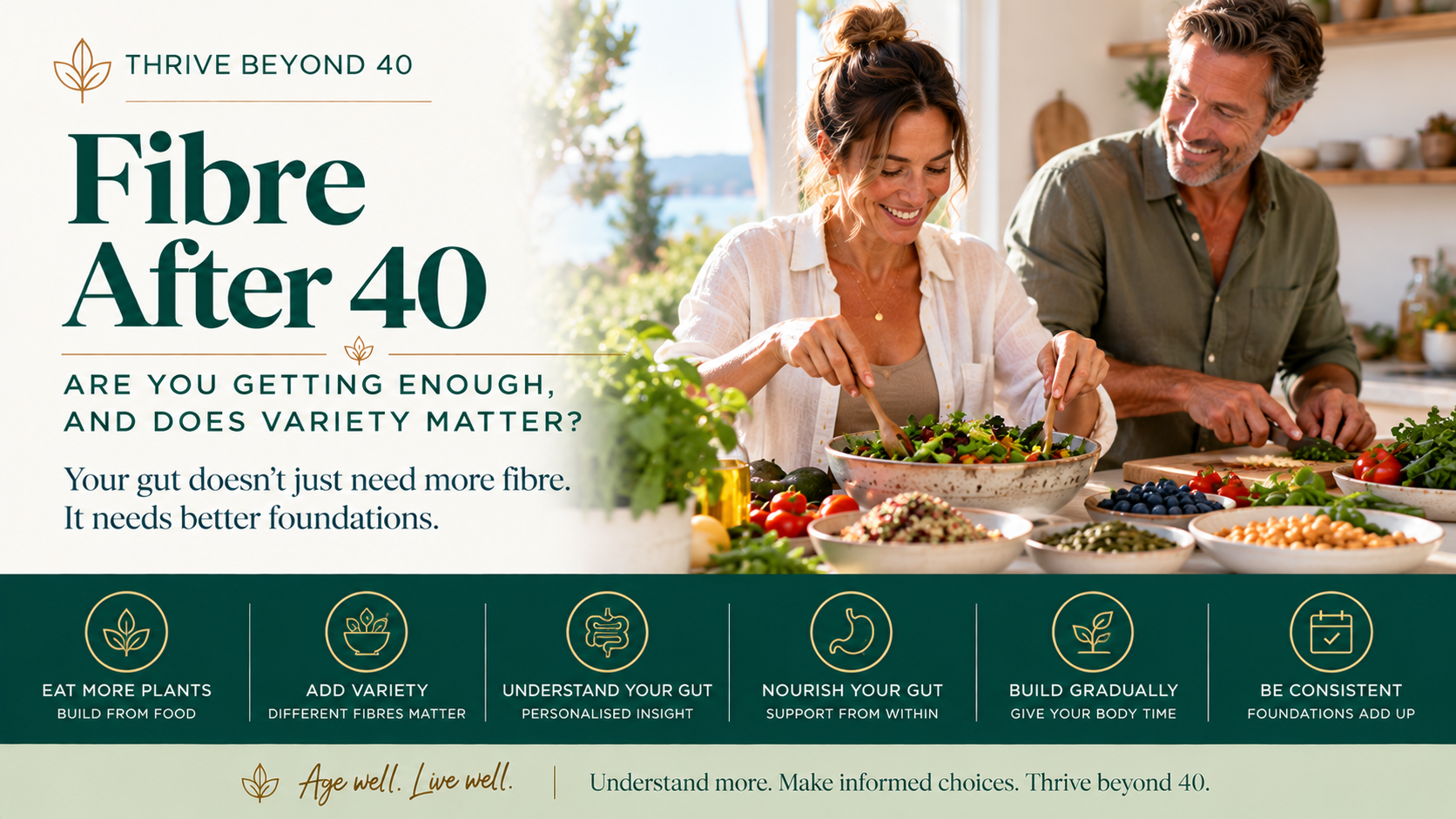
Fibre After 40: Are You Getting Enough, and Does Variety Matter? →
What Is Silent Inflammation? Why It Matters After 40 →
Perimenopause and Healthy Ageing: Looking Beyond the Symptoms →
Keywords: gut health after 40, gut microbiome, microbiome after 40, fibre diversity, prebiotic fibre, resistant starch, digestive health, healthy ageing
Category: Gut Health