By
By
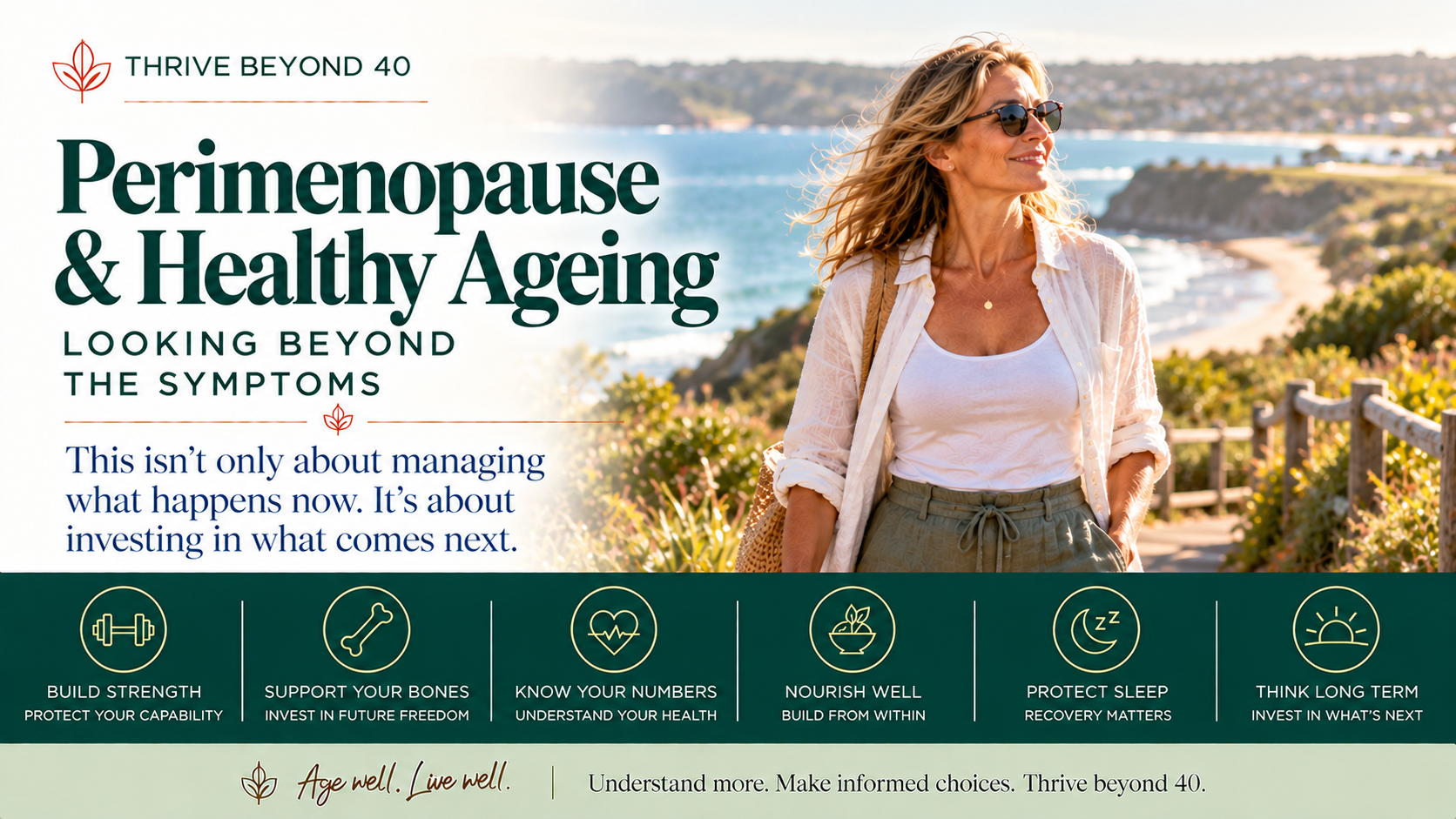
Perimenopause isn't only about managing what's happening now. It's an opportunity to think about what comes next.
Hot flushes.
Broken sleep.
Brain fog.
Changing periods.
Mood changes.
Weight that suddenly seems to behave differently.
Skin that doesn't quite feel like your skin anymore.
For many women, perimenopause announces itself through symptoms.
And when those symptoms are affecting everyday life, understandably, the immediate question becomes:
How do I make this better?
That's an important conversation.
Women deserve to have their symptoms taken seriously and to understand the treatment and support options available to them.
But I think there's another conversation worth having at the same time.
What if perimenopause isn't only a stage to get through?
What if it's also a prompt to think differently about how we want to age?
Because somewhere in the middle of managing periods, sleep and hormones, we're also entering an important period for our future health.
And that deserves attention too.
Perimenopause is a transition, not a diagnosis
Perimenopause is the transition leading up to menopause, when ovarian hormone production begins to change and fluctuate.
It can start years before the final menstrual period.
And no two women experience it exactly the same way.
Some women have significant symptoms.
Others have relatively few.
Some notice changes in their early 40s.
Others later.
Symptoms can include changes to menstrual cycles, hot flushes, night sweats, sleep disturbance, mood changes, joint or muscle discomfort, vaginal and urinary symptoms, changes in sexual wellbeing and difficulties with concentration or memory.
But not every change that happens in your 40s is automatically caused by hormones.
That's an important distinction.
Perimenopause can be part of the picture without becoming the explanation for everything.
Persistent or concerning symptoms still deserve proper medical assessment.
The conversation needs to be bigger than symptoms
There's an enormous amount of content aimed at women in perimenopause.
How to stop hot flushes.
How to lose menopause weight.
How to fix brain fog.
How to sleep.
How to balance hormones.
Some of it is useful.
Some of it isn't.
But I think we're missing something when the entire conversation becomes:
How do I get my old body back?
Because healthy ageing isn't about trying to freeze ourselves at 35.
We're moving forward.
The more useful question may be:
What does my body need now to help me stay strong, capable and well in the years ahead?
That shifts the focus.
From fixing.
To investing.
Your heart deserves a place in the perimenopause conversation
We touched on this in our article about heart health after 40, but it's important enough to repeat.
Cardiovascular health matters enormously for women.
And midlife is an excellent time to start paying closer attention to it.
As women move through menopause, changes can occur in cardiovascular risk factors including cholesterol, blood pressure, blood glucose and body-fat distribution.
That doesn't mean menopause suddenly causes heart disease.
It means this is a useful time to understand your cardiovascular health rather than assuming everything is fine because you feel well.
Know your blood pressure.
Understand your cholesterol.
Know your blood glucose or diabetes risk where appropriate.
Understand your family history.
Move.
Don't smoke.
Be thoughtful about alcohol.
Attend appropriate preventive health checks.
Looking after your heart isn't something to save for your 60s.
Start now.
Your bones are changing too
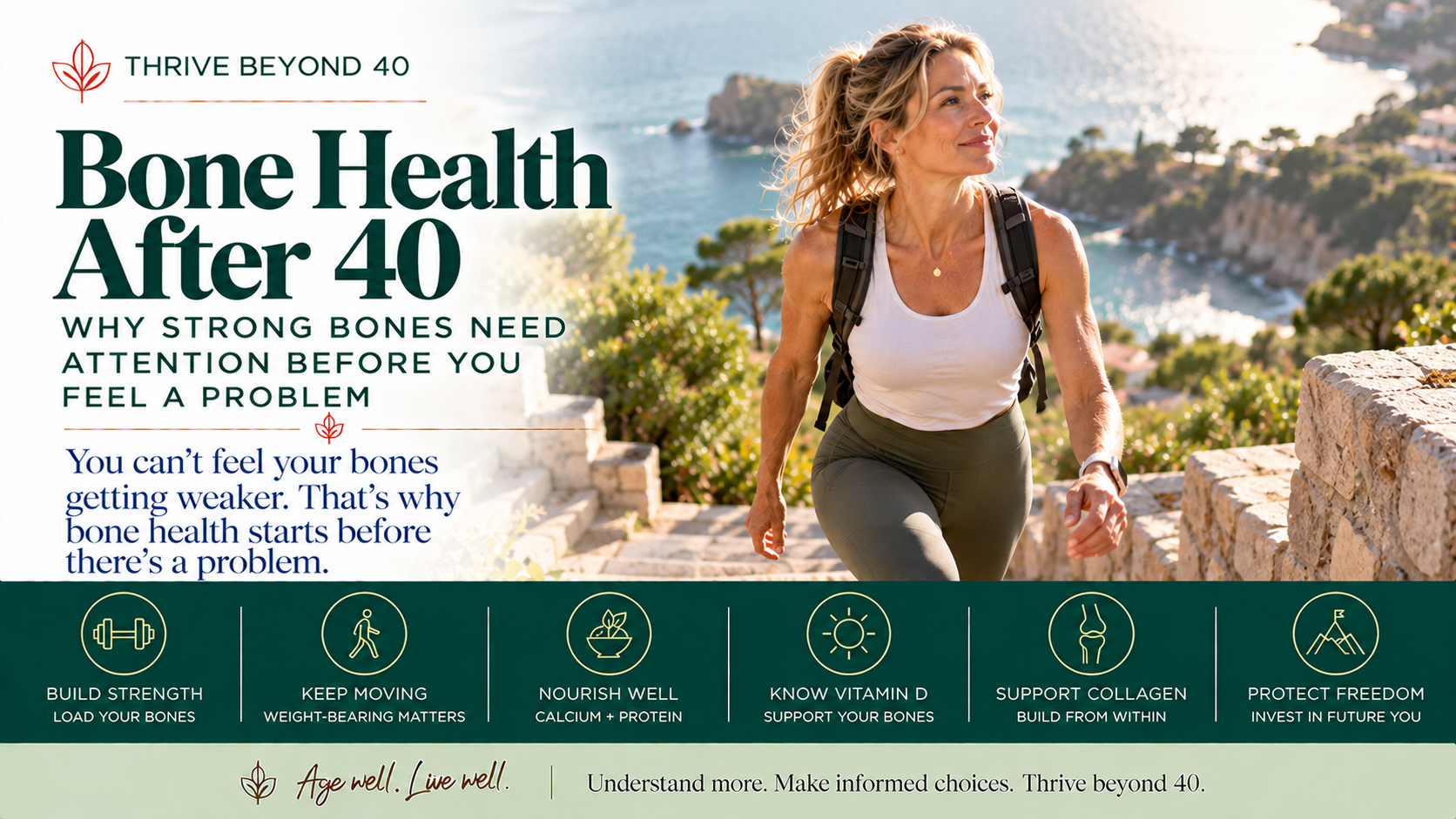
Bone health is one of the biggest reasons I think the perimenopause conversation needs to move beyond symptoms.
Oestrogen plays an important role in maintaining bone.
As oestrogen levels decline around menopause, bone loss can accelerate.
The problem?
You generally can't feel your bones becoming less dense.
There may be no obvious warning sign.
That's why bone health is such a good example of preventive healthy ageing.
You don't wait until your bones feel weak.
You build the conditions that help support them earlier.
Weight-bearing movement.
Resistance training.
Adequate nutrition.
Protein.
Calcium.
Vitamin D.
Avoiding smoking.
Being sensible about alcohol.
And discussing your individual risk factors with your doctor.
If you have risk factors for osteoporosis or low bone density, your GP can advise whether further assessment is appropriate.
Strong bones are an investment in future freedom.
Muscle may be one of your best healthy-ageing assets
If I could encourage women in their 40s to embrace one thing, it would be this:
Get stronger.
Not smaller.
Stronger.
Muscle supports far more than how your body looks.
It contributes to physical capability.
Movement.
Balance.
Metabolic health.
Bone health.
Your ability to carry groceries, lift luggage, climb stairs, get off the floor and keep doing the things you enjoy.
And maintaining muscle becomes increasingly important as we age.
You don't need to train like an athlete.
But resistance training deserves a place in your week.
Weights.
Machines.
Resistance bands.
Body-weight exercises.
Whatever works for you.
Strength isn't about becoming someone else.
It's about preserving more of what you want your body to be able to do.
Body composition can change, and that can feel confronting
This deserves a compassionate but realistic conversation.
Many women notice changes in body composition during midlife.
Perhaps weight moves towards the abdomen.
Perhaps maintaining the same weight requires more effort.
Perhaps the body you've known for decades suddenly looks or feels different.
Hormonal changes can contribute, but they're not acting alone.
Ageing.
Muscle mass.
Activity.
Sleep.
Stress.
Diet.
Alcohol.
Genetics.
Life circumstances.
They all matter.
And this is exactly where women can become vulnerable to extreme diets and promises of rapid "menopause weight loss".
I don't think the answer is punishing your changing body.
Support it.
Build muscle.
Move regularly.
Eat enough protein.
Choose mostly nourishing foods.
Prioritise fibre and plants.
Protect sleep.
Pay attention to metabolic health.
If fat loss is appropriate for you, approach it in a way that still supports the body you're taking into older age.
Healthy ageing shouldn't require sacrificing muscle, energy and enjoyment just to make the scales move faster.
Protein becomes increasingly relevant
Protein tends to become more important in healthy-ageing conversations because maintaining muscle requires both stimulus and nutrition.
Resistance training provides the stimulus.
Protein provides amino acids your body uses for building and maintaining tissues.
That doesn't mean every meal needs to resemble a bodybuilding diet.
It means being intentional.
Include good-quality protein across your day.
Fish.
Eggs.
Dairy foods if you eat them.
Lean meat.
Chicken.
Tofu.
Tempeh.
Legumes.
Nuts and seeds.
Whatever suits your dietary pattern.
Think about nourishing muscle, not simply reducing calories.
That's a very different mindset.
Your gut doesn't stop mattering because your hormones are changing
Bloating and changes in digestion are often reported around midlife.
But gut health is much bigger than whether your stomach feels flat.
Your gastrointestinal tract is home to a complex microbial ecosystem, and diet, particularly the variety and types of fibre we consume, helps shape that environment.
This is why I keep coming back to plants.
Vegetables.
Fruit.
Legumes.
Wholegrains.
Nuts.
Seeds.
Different fibres.
Different colours.
Different plant foods.
Not because there's a magical "menopause microbiome diet".
There isn't.
Because diverse, fibre-rich food is a strong nutritional foundation at any age.
Perimenopause doesn't suddenly make the fundamentals irrelevant.
If anything, it's a good time to become more consistent with them.
Omega-3 belongs in the healthy-ageing picture
Another nutritional area worth paying attention to is omega-3.
The long-chain omega-3 fatty acids EPA and DHA have established roles in normal physiology, including normal heart function, while DHA contributes to normal brain function.
They're found predominantly in oily fish and marine sources.
At Thrive Beyond 40, I'm particularly interested in omega-3 because fatty-acid status can also be measured.
The BalanceTest provides insight into 11 fatty acids and several markers, including your Omega-3 Index and Omega-6:3 Balance.
For me, that's more useful than simply assuming:
"I eat fairly well, so I'm probably fine."
Test where information can genuinely help you make a better decision.
Then support what needs supporting.
That's the philosophy behind our Balance Program:
TEST → UNDERSTAND → SUPPORT → RETEST
Not because one test tells us everything about your health.
It doesn't.
But because personalised information can sometimes help turn general healthy advice into something more meaningful.
Sleep can become one of the biggest challenges
For some women, poor sleep is one of the most disruptive parts of perimenopause.
Night sweats can wake you.
Hormonal changes may affect sleep.
Stress can affect sleep.
Alcohol can affect sleep.
Children can affect sleep.
Life can affect sleep.
And then poor sleep begins affecting everything else.
Mood.
Concentration.
Appetite.
Exercise.
Recovery.
Energy.
Patience.
That's why sleep deserves to be treated as a health foundation rather than an inconvenience.
If your sleep has changed significantly, don't simply assume:
"I'm in my 40s. This is just what happens."
There may be things you can change.
And there may be treatment options worth discussing with your doctor.
You deserve better than simply learning to function while exhausted.
Brain fog doesn't mean your brain is failing
Forgetting why you walked into a room.
Losing words halfway through a sentence.
Reading the same paragraph three times.
Opening your laptop and forgetting what you were about to do.
Many women report cognitive changes during perimenopause.
That can be unsettling.
But brain fog doesn't automatically mean something is seriously wrong with your brain.
Hormonal changes may contribute.
So can disrupted sleep.
Stress.
Mental load.
Mood.
Nutrition.
And simply having far too many things competing for your attention.
Your brain deserves the same long-term investment as the rest of your body.
Movement.
Sleep.
Good nutrition.
Cardiovascular health.
Social connection.
Learning.
Mental stimulation.
Appropriate medical assessment when something doesn't feel right.
Healthy ageing includes your brain too.
And yes, it's okay to care about how you look
Healthy ageing sometimes becomes so serious that we're almost embarrassed to talk about appearance.
I don't think we need to be.
It's okay to want healthy-looking skin.
Strong hair.
Healthy nails.
A body you feel confident in.
To look in the mirror and feel good.
Perimenopause can coincide with changes to skin, including dryness, elasticity and collagen.
Collagen itself also changes as we age, with menopause representing a particularly relevant period for skin collagen.
That's part of why our Collagen Renewal Program sits within Thrive Beyond 40.
Not because looking younger is the goal.
Because looking well can be part of feeling well.
Beauty and healthy ageing don't have to compete.
What about menopause hormone therapy?
This deserves to be said clearly.
Menopause hormone therapy, often referred to as MHT, is an established medical treatment that can be appropriate for many women experiencing menopausal symptoms.
Whether it's suitable for you depends on your symptoms, medical history, individual risk factors and preferences.
That's a conversation to have with a qualified health professional.
Thrive Beyond 40 isn't here to replace that conversation.
And nutritional support shouldn't be positioned as an alternative to appropriate medical treatment.
Evidence-informed healthy ageing means knowing where lifestyle belongs, where nutrition belongs and where healthcare belongs.
They can complement each other.
They don't have to compete.
Don't let "hormone balancing" become the new detox
Perimenopause has created an enormous wellness market.
Supplements.
Powders.
Teas.
Detoxes.
Hormone resets.
Cortisol hacks.
Metabolism boosters.
Some products may have evidence behind particular ingredients.
Others make promises far beyond what the evidence supports.
Be curious.
Ask questions.
What exactly is this supposed to do?
What's in it?
What evidence supports it?
Is this addressing a real nutritional need?
Could it interact with medication?
Am I buying this because it's useful, or because someone has made me frightened of my hormones?
Your hormones aren't toxins that need to be cleansed.
Your body is transitioning.
Support it intelligently.
Don't forget the health checks that have nothing to do with menopause
It's easy for "women's health after 40" to become synonymous with hormones.
But preventive health is bigger.
Depending on your age, history and individual circumstances, conversations with your healthcare team may include things such as:
Blood pressure.
Cholesterol and cardiovascular risk.
Blood glucose.
Cervical screening.
Breast screening.
Bone health.
Bowel screening as you become eligible.
Vaccinations.
Mental health.
Skin checks where appropriate.
Dental health.
Vision.
Hearing.
Medication review.
Not all at once.
Not because you should spend your life looking for disease.
Because prevention gives us opportunities.
And opportunities are valuable.
This isn't the beginning of decline
This may be the most important part of the conversation.
Perimenopause is often framed as though a woman has crossed an invisible line into becoming old.
I reject that idea.
Your 40s and 50s can be decades of enormous capability.
Experience.
Confidence.
Career.
Family.
Travel.
Strength.
Friendships.
Sex.
Adventure.
Purpose.
Growth.
And yes, change.
Your body may need different things than it did at 25.
That's not failure.
Healthy ageing isn't about becoming younger.
It's about becoming better equipped for what's ahead.
Use perimenopause as a health reset
Not a detox.
Not a 30-day challenge.
Not an attempt to recreate your 30-year-old body.
A genuine reset in how you think about your future health.
Ask yourself:
Do I know my blood pressure?
Do I understand my cholesterol and metabolic health?
Am I building strength?
Am I protecting my bones?
Am I eating enough protein and fibre?
Am I getting enough omega-3?
Am I moving regularly?
Am I sleeping well enough to recover?
Am I keeping up with preventive health checks?
Do I have symptoms I should actually discuss with my doctor?
And perhaps most importantly:
What do I want my body to allow me to do 20 years from now?
Travel?
Hike?
Work?
Dance?
Play with grandchildren?
Carry your own suitcase?
Live independently?
Keep saying yes to things?
Start there.
Then work backwards.
Because perimenopause isn't only about managing what your body is doing today.
It's an opportunity to start building the body and health you want for tomorrow.
Understand more.
Build strength.
Nourish well.
Protect your future.
Keep living.
Health is the foundation. Life is the point.
Age Well. Live Well.
Ready to think beyond the symptoms?
Your next chapter deserves strong foundations.
Thrive Beyond 40 takes a broader approach to healthy ageing, bringing together evidence-informed education, personalised insights, nutrition and sustainable lifestyle foundations.
Because this stage of life isn't only about getting through perimenopause.
It's about investing in what comes after it.
Continue exploring
Sleep After 40: Why Recovery Matters More Than You Think →
Heart Health After 40: The Foundations Worth Paying Attention To →
Collagen After 40: Skin Is Only Part of the Story →
Omega-3 After 40: What You Need to Know →
Keywords: perimenopause healthy ageing, perimenopause health, menopause health, women’s health after 40, bone health menopause, heart health menopause, strength after 40, healthy ageing women
Category: Women's Health