By
By
Ageing is inevitable. How we experience it isn't entirely out of our hands.
Most of us don't actually want to live forever.
What we want is more good years.
Years when we can travel.
Walk for hours through a new city.
Get down on the floor with children or grandchildren and get back up again.
Carry our own bags.
Think clearly.
Feel confident in our clothes.
Keep working if we choose to.
Enjoy good food.
Stay connected.
And continue saying yes to the things that make life interesting.
That's the real conversation behind healthy ageing.
Not:
How do I stop getting older?
But:
How do I stay healthier, stronger and more capable while I do?
And increasingly, that's where the science of ageing is focusing too.
Lifespan and healthspan aren't the same thing
Lifespan is simply how long we live.
Healthspan describes the period of life we spend in relatively good health.
That distinction matters.
Modern medicine has become remarkably good at helping people live longer. But adding years to life isn't quite the same as adding healthy, independent and enjoyable years.
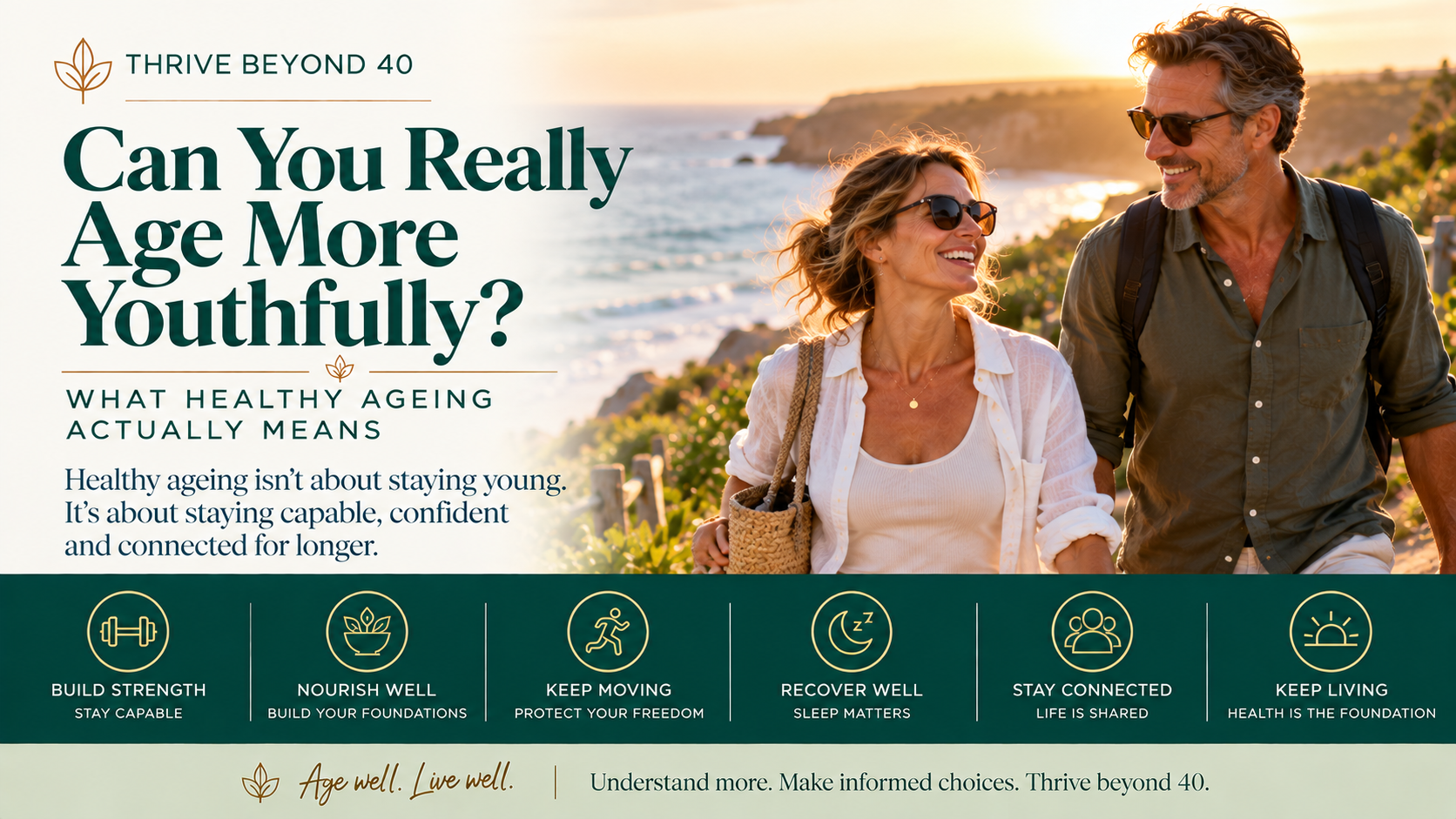
The World Health Organization describes healthy ageing in terms of developing and maintaining the functional ability that enables wellbeing in older age. That includes a person's physical and mental capacities, their environment and the interaction between the two.
I like that definition because it shifts the conversation away from appearance alone.
Healthy ageing isn't about pretending you're younger.
It's about preserving your ability to live well.
So can you actually age more youthfully?
It depends what we mean by youthfully.
If we mean stopping biological ageing altogether, no.
Ageing is a normal biological process.
Our skin changes.
Hormones change.
Muscle mass and strength can change.
Bone density can change.
Recovery can feel different.
Our cardiovascular system changes.
And our risk of many chronic conditions increases with age.
But chronological age doesn't tell us everything about how someone will function at 50, 60, 70 or beyond.
Physical activity, nutrition, smoking, alcohol, sleep, social connection and other lifestyle and environmental factors can all contribute to health across the life course.
So perhaps ageing youthfully is the wrong goal.
Ageing well is the better one.
Healthy ageing isn't about becoming obsessed with longevity
Longevity has become fashionable.
Cold plunges.
Wearables.
Supplements.
Biological-age tests.
Elaborate morning routines.
Endless metrics.
Some of these things can be useful or interesting.
But healthy ageing doesn't need to become another full-time job.
The fundamentals remain remarkably familiar.
Move your body.
Build and maintain strength.
Eat well.
Don't smoke.
Drink alcohol cautiously.
Sleep.
Maintain relationships.
Look after your cardiovascular and metabolic health.
Stay engaged with life.
And participate in appropriate preventive healthcare and screening.
The difficult part isn't knowing that these things matter.
It's doing enough of them consistently for long enough.
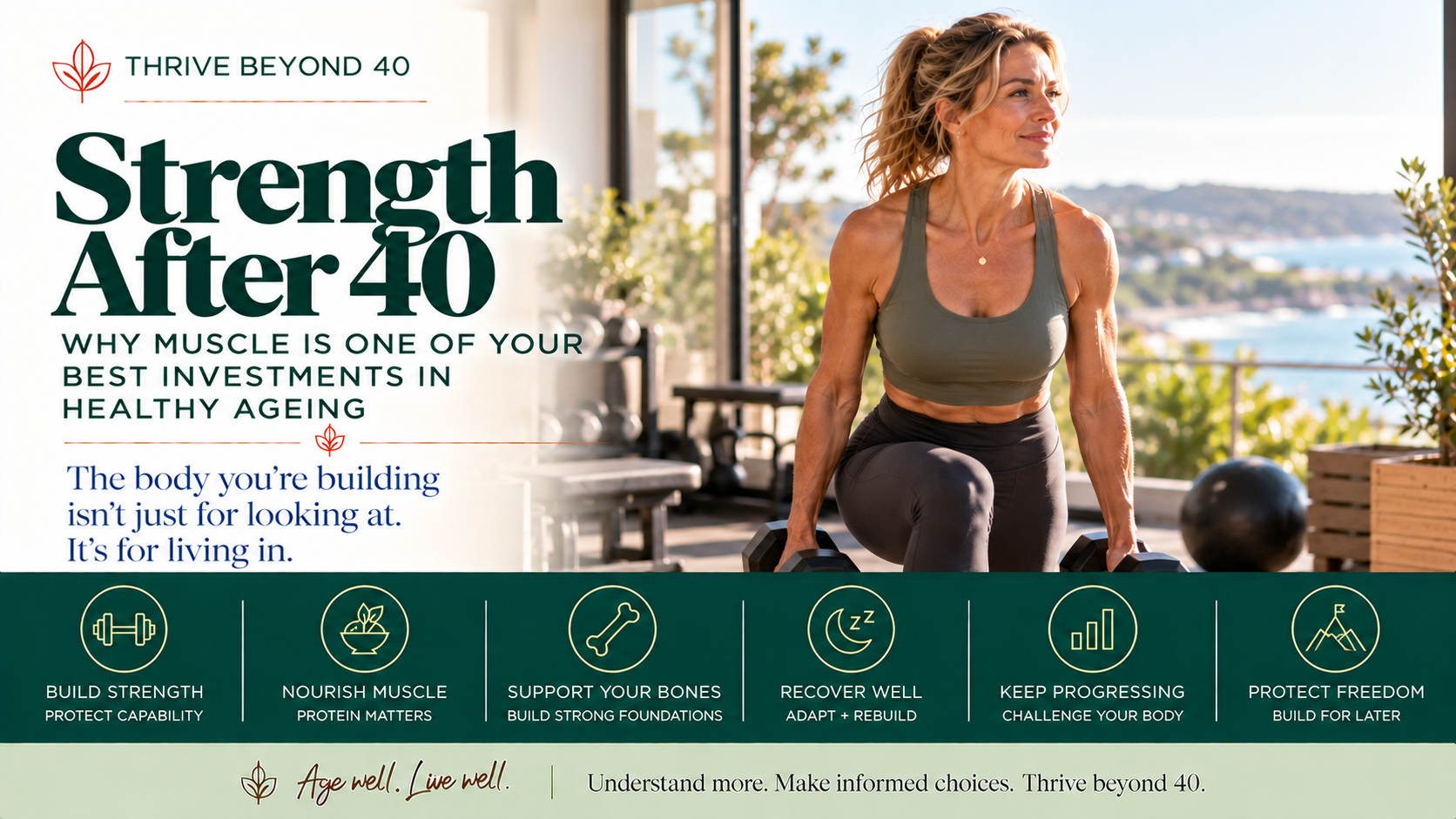
Strength is one of the most valuable things you can carry forward
If there's one idea I'd love more people to take seriously after 40, it's this:
Muscle is about much more than appearance.
Strength supports everyday function.
Getting out of a chair.
Climbing stairs.
Carrying groceries.
Lifting luggage.
Maintaining balance.
Continuing to participate in the activities you enjoy.
Age-related declines in muscle mass, strength and physical performance can contribute to reduced function later in life, which is why resistance and strength-based activity becomes increasingly important as we age.
You don't need to become a bodybuilder.
But your future self will benefit from having something to preserve.
Build strength now. Keep using it.
Your bones deserve the same attention
Bone is living tissue.
And while we often don't think about bone health until much later in life, the foundations matter long before then.
Women deserve particular attention here because the hormonal changes associated with menopause can accelerate bone loss.
Physical activity, particularly appropriate weight-bearing and resistance exercise, adequate nutrition and attention to key nutrients all form part of supporting bone health across adulthood.
Healthy ageing isn't simply about what you can see in the mirror.
It's also about the structures underneath that allow you to keep moving through the world.
Eat for the life you want to keep living
Nutrition after 40 doesn't need to mean restriction.
In fact, constantly eating less isn't necessarily the most useful mindset for healthy ageing.
A better question is:
What does my body need me to give it?
Protein to support muscle.
Plants and fibre to support nutritional and digestive foundations.
Healthy fats.
Wholegrains.
Fruit and vegetables.
Calcium-rich foods.
Adequate micronutrients.
Enough energy to support an active life.
And enjoyment.
Food is not simply fuel.
It's culture.
Connection.
Pleasure.
Celebration.
Healthy ageing should leave room for all of those things.
The goal isn't a perfect diet.
It's a dietary pattern that supports the person you're trying to become.
Understand your body rather than simply guessing
This is where the Thrive Beyond 40 approach becomes more personal.
General health advice matters.
But your body isn't generic.
Your nutritional status, lifestyle, family history, stage of life, activity levels and health priorities are individual.
That's why I'm interested in moving beyond:
"Everyone should take this."
towards:
What does your body actually need?
Sometimes that means working with your healthcare practitioner.
Sometimes it means routine health checks.
Sometimes it means looking at your blood pressure, cholesterol or other clinically appropriate markers.
And in nutritional areas where validated testing is available, it can mean establishing a baseline before deciding what support makes sense.
That's the thinking behind our approach:
UNDERSTAND → SUPPORT → MEASURE → THRIVE
Know more.
Make informed choices.
Then see what changes.
Sleep isn't wasted time
Sleep can become one of the first things we sacrifice when life gets busy.
Work.
Children.
Caring responsibilities.
Screens.
Stress.
Hormonal changes.
Everything seems to compete with it.
But sleep is not simply the absence of productivity.
It's part of the biological foundation that allows us to function.
Sleep affects attention, mood, recovery and many aspects of physical health, while persistent inadequate sleep is associated with poorer health outcomes.
After 40, recovery deserves to become part of the plan.
Not something we squeeze in after everything else.
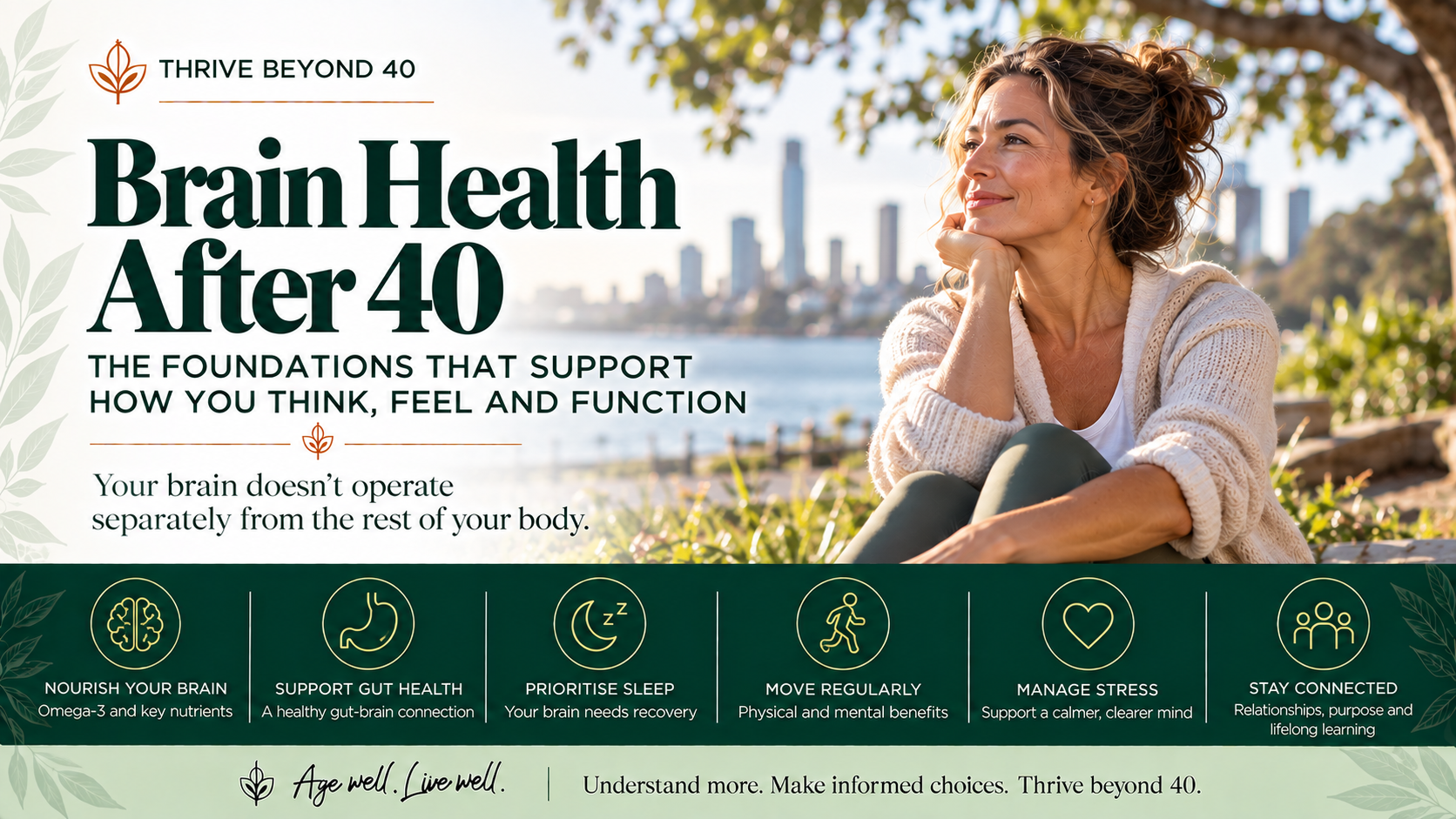
Your brain needs investment too
Healthy ageing isn't only physical.
We want our bodies to remain capable.
But we also want our minds to remain engaged.
Learning.
Thinking.
Remembering.
Connecting.
Creating.
The Lancet Commission on dementia prevention has identified a range of potentially modifiable factors across the life course associated with dementia risk, including physical inactivity, smoking, social isolation, hearing loss, hypertension and other health and lifestyle factors.
That doesn't mean dementia can always be prevented.
It means brain health belongs in the healthy-ageing conversation long before old age.
Exercise.
Cardiovascular health.
Social connection.
Learning.
Hearing.
Sleep.
Nutrition.
They aren't separate little wellness projects.
They're part of the same body.
Connection may be one of the most underrated healthy-ageing habits
There is something longevity culture occasionally misses.
We can become so focused on optimising ourselves that we forget one of the reasons we want to live longer in the first place:
Other people.
Family.
Friendships.
Community.
Shared meals.
Laughter.
Belonging.
Purpose.
The World Health Organization includes the ability to build and maintain relationships and contribute to society within its concept of functional ability and healthy ageing.
That's worth remembering.
A long life filled with supplements, perfect biomarkers and no meaningful connection isn't the vision.
Health is the foundation.
Life is the point.
Looking well can belong in healthy ageing too
Healthy ageing doesn't need to pretend appearance doesn't matter.
It can.
We can care about our skin.
Our hair.
Our body composition.
Our clothes.
Our confidence.
How we look in photographs.
How we feel when we walk into a room.
Wanting to look vibrant as you age isn't incompatible with accepting ageing.
The distinction, for me, is between fighting age and caring for yourself as you age.
One comes from fear.
The other can come from investment.
And there is room in healthy ageing for beauty, confidence and feeling good in your body.
Prevention doesn't mean guaranteeing the future
This distinction matters.
You can do everything "right" and still become unwell.
Genetics matter.
Environment matters.
Chance matters.
Access to healthcare matters.
And not every condition is preventable.
Healthy ageing shouldn't become another way of blaming people for becoming sick.
Instead, think of prevention as improving the foundations you can influence.
Keeping up with appropriate health checks.
Understanding your risk factors.
Moving.
Building strength.
Eating well.
Sleeping.
Maintaining relationships.
Seeking healthcare when something changes.
And making informed decisions earlier rather than waiting until health becomes a crisis.
You don't need to optimise everything
This might be the most reassuring part.
You don't need:
The perfect diet.
The perfect supplement routine.
The perfect sleep score.
The perfect body.
The perfect exercise program.
Or the perfect set of biomarkers.
Healthy ageing isn't an exam you're trying to get 100% on.
It's a direction of travel.
One walk.
One strength session.
One better breakfast.
One earlier night.
One health check.
One phone call to a friend.
One decision to understand your body better.
Repeated often enough, small choices become patterns.
And patterns become part of how we age.
What does ageing well actually look like?
It won't look exactly the same for everyone.
For one person, it might mean running at 60.
For another, travelling at 70.
For someone else, keeping up with grandchildren.
Continuing to work.
Gardening.
Swimming.
Dancing.
Living independently.
Feeling confident.
Thinking clearly.
Having the energy to say yes.
That's why I don't think the ultimate goal of healthy ageing should be:
Live as long as possible.
I'd rather ask:
What do you want to still be able to do?
Then start building the health that supports it.
The best time to invest in later is before you get there
Your 40s and 50s are interesting decades.
You're old enough to understand that health isn't guaranteed.
But young enough that there may still be decades of life ahead.
That's an opportunity.
Not to become frightened of ageing.
Not to become obsessed with preventing every wrinkle.
And certainly not to spend your life worrying about what might happen.
But to become more intentional.
To understand your body.
To build strength.
To nourish yourself.
To protect your sleep.
To care for your relationships.
To use preventive healthcare.
And to make choices that support the kind of later life you actually want.
Because healthy ageing isn't about trying to become younger.
It's about staying you for longer.
Capable.
Curious.
Strong.
Connected.
Confident.
And still making plans.
Health is the foundation. Life is the point.
Age Well. Live Well.
Ready to invest in the years ahead?
Start with understanding.
Thrive Beyond 40 brings together evidence-informed health education, personalised insights and considered programs designed to help you take a more proactive approach to healthy ageing.
You don't need to change everything today.
You simply need somewhere meaningful to begin.
Continue exploring
Healthspan vs Lifespan: What's the Difference? →
Recovery After 40: Why Your Body Needs a Different Approach →
Fibre After 40: Are You Getting Enough, and Does Variety Matter? →
Keywords: healthy ageing after 40, ageing well, healthy ageing, longevity, healthspan, age more youthfully, active ageing, how to age well
Category: Healthy Ageing & Longevity