By
By
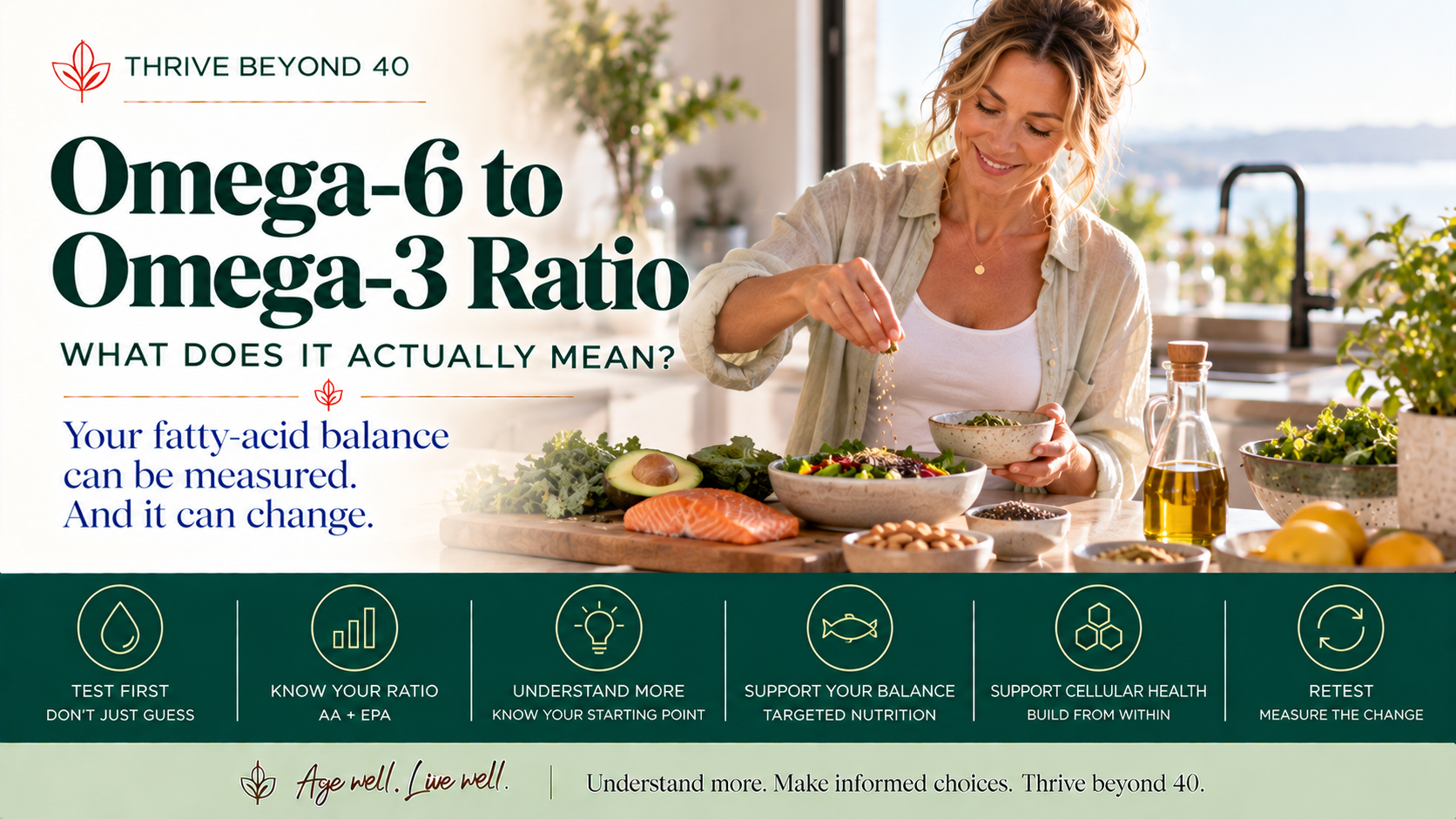
Your fatty-acid balance can be measured. And it can change.
Omega-3 is one of those nutrients most of us know we're supposed to be getting.
Eat oily fish.
Take fish oil.
Choose omega-3 eggs.
Perhaps add a supplement.
Tick the box.
But there's a question I find much more interesting:
How do you know what your fatty-acid balance actually looks like?
Because taking omega-3 and understanding your omega-3 status aren't quite the same thing.
And this is where the conversation about omega-6 and omega-3 becomes much more personal.
At Thrive Beyond 40, we don't start with:
"You should take more omega-3."
We start with:
What does your body tell us?
Test.
Understand.
Support.
Retest.
That's the philosophy behind our Balance Program.
And once you understand what is actually being measured, the numbers become much more meaningful.
First, what are omega-6 and omega-3?
Omega-6 and omega-3 are both families of polyunsaturated fatty acids.
And this is important:
We need both.
Omega-6 isn't the villain.
Omega-3 isn't the hero riding in to rescue us from it.
Your body uses fatty acids for many normal physiological functions, and both omega-6 and omega-3 fatty acids can form part of a healthy diet.
Omega-6 fatty acids are commonly found in foods including nuts, seeds and vegetable oils.
Omega-3 fatty acids come in several forms.
Plant foods such as flaxseed, chia seeds and walnuts provide ALA, or alpha-linolenic acid.
Marine foods such as salmon, sardines, mackerel, herring and trout provide the long-chain omega-3 fatty acids EPA and DHA.
They're related.
But they're not interchangeable.
The individual fatty acids matter.
So why does everyone talk about the "ratio"?
This is where things can become confusing.
You may have seen claims online suggesting that humans need a particular dietary omega-6 to omega-3 ratio.
Perhaps 4:1.
3:1.
2:1.
Or even 1:1.
The science isn't that simple.
Research has questioned whether a single dietary omega-6:omega-3 ratio is particularly useful because the ratio can hide what's actually happening with the individual fatty acids.
Two people could theoretically have the same ratio while consuming very different absolute amounts of omega-3 and omega-6.
And importantly, evidence doesn't support the simplistic idea that we should reduce healthy omega-6 foods simply because omega-6 is inherently inflammatory or harmful.
More useful question:
What fatty acids are you actually getting?
And what does your own fatty-acid profile look like?
The BalanceTest measures something much more specific
This distinction is important.
When we talk about the Omega-6:3 Balance within the Thrive Beyond 40 Balance Program, we're not simply calculating the amount of omega-6 food you eat divided by the amount of omega-3 food you eat.
The BalanceTest measures fatty acids from a small dried blood sample.
It analyses 11 fatty acids and uses those results to calculate six markers relating to your fatty-acid profile.
One of those is your Omega-6:3 Balance.
And for this particular marker, the test compares two specific fatty acids:
AA, or arachidonic acid, an omega-6 fatty acid.
and
EPA, or eicosapentaenoic acid, an omega-3 fatty acid.
The calculation is:
AA ÷ EPA = Omega-6:3 Balance
The BalanceTest target for this marker is:
Below 3:1.
That's much more specific than saying:
"Omega-6 is bad, so eat less of it."
It gives us a measurable relationship between AA and EPA in your fatty-acid profile.
What does a result above 3:1 mean?
This is where I want to be careful with language.
It doesn't mean:
Your body is inflamed.
You have heart disease.
You're unhealthy.
Or omega-6 is poisoning your cells.
The BalanceTest is a nutritional self-screening tool, not a diagnostic test.
A result above the program's target simply tells us that the relationship between AA and EPA in your sample sits above the target range used within the Balance Concept.
It's information.
And information gives us somewhere to start.
Instead of blindly taking a supplement, you now have a baseline you can measure again later.
Why EPA deserves attention
EPA is one of the major long-chain marine omega-3 fatty acids.
Alongside DHA, it is found particularly in oily fish and marine omega-3 sources.
EPA and DHA have established physiological roles, including contributing to normal heart function at appropriate intakes.
DHA also contributes to the maintenance of normal brain function and normal vision.
Omega-3 fatty acids are also incorporated into cell membranes throughout the body.
This is one reason I think omega-3 deserves attention after 40.
Not because it's a miracle nutrient.
Because it's part of our nutritional foundation.
Your cells are part of the story
This is where fatty acids become much more interesting than a number on a supplement bottle.
Your body is made up of trillions of cells.
Each cell is surrounded by a membrane.
Fatty acids are important structural components of those membranes, and the fatty acids incorporated into cell membranes contribute to their physical properties.
Both omega-3 and omega-6 fatty acids can become part of these structures.
That's why the Balance approach looks at fatty-acid nutrition through a broader cellular-health lens.
Not because one ratio can tell us whether your cells are "healthy" or "unhealthy".
It can't.
But because your fatty-acid profile provides personalised information about some of the fats available within your body.
Cellular health starts with the right nutritional foundations.
This is why I prefer testing to guessing
Imagine two people.
Both say:
"I take omega-3."
One eats oily fish several times a week and takes a high-quality marine omega-3 consistently.
The other occasionally takes a low-dose fish-oil capsule when they remember.
They're both technically "taking omega-3".
But that's not very useful information.
Diet differs.
Dosage differs.
EPA and DHA content differs.
Consistency differs.
Body size differs.
Individual fatty-acid status differs.
The supplement bottle can't tell you your result.
Testing can.
That's the principle I like:
TEST → UNDERSTAND → SUPPORT → RETEST
What else does the BalanceTest show?
The AA:EPA relationship isn't the only information we get.
The BalanceTest analyses 11 fatty acids and calculates six markers.
These include your Omega-6:3 Balance and Omega-3 Index, alongside other markers derived from your measured fatty acids.
The Omega-3 Index gives additional insight into your EPA and DHA status.
That matters because it prevents us from becoming obsessed with one ratio.
One marker gives us one piece of information.
Your broader fatty-acid profile gives us context.
And your overall health requires a much bigger picture again.
Don't try to "eliminate" omega-6
This is one of the biggest misconceptions I want this article to correct.
You may encounter advice online telling you to dramatically reduce omega-6 because it "causes inflammation".
That's an oversimplification.
Linoleic acid, the major dietary omega-6 fatty acid, is an essential fatty acid.
Foods containing omega-6 can also be highly nutritious.
Nuts.
Seeds.
Other whole foods.
The goal isn't to become frightened of omega-6.
Research has also questioned whether focusing on the dietary omega-6:omega-3 ratio is more useful than ensuring adequate intake of the individual fatty acids, particularly long-chain omega-3s.
Don't declare war on one nutrient.
Build a better nutritional pattern.
Start with food
Before we talk about targeted supplementation, food matters.
Good marine sources of EPA and DHA include:
Salmon
Sardines
Mackerel
Herring
Trout
and other oily fish and seafood.
Plant sources such as chia, flax and walnuts provide ALA.
They're nutritious foods, but conversion of ALA into the longer-chain omega-3 fatty acids EPA and DHA is limited.
So if you're specifically thinking about EPA and DHA, marine sources deserve attention.
At the same time, build the bigger dietary pattern.
Vegetables.
Fruit.
Wholegrains.
Legumes.
Nuts.
Seeds.
Quality protein.
Extra virgin olive oil.
Food and lifestyle foundations first.
Targeted nutrition where it adds value.
Where BalanceOil+ fits
Once we know your starting point, targeted nutritional support becomes much more meaningful.
Within the Balance Program, we use BalanceOil+.
It combines marine omega-3 fatty acids, including EPA and DHA, with extra virgin olive oil.
The olive oil component provides oleic acid and polyphenols, giving the formulation a broader lipid and antioxidant profile than a basic fish-oil capsule.
Your daily amount is calculated according to body weight rather than simply using one generic amount for everyone.
And that nutritional routine sits between two tests.
Test first.
Support consistently.
Measure again.
That's the part I find compelling.
BalanceOil+ isn't being taken in isolation from the information.
It becomes part of a test-based nutrition approach.
Omega-3 also belongs in the heart-health conversation
We've explored this more deeply in our article Heart Health After 40, but it's worth touching on here.
EPA and DHA contribute to normal heart function.
At appropriate intakes, long-chain omega-3s can also influence triglyceride levels, although the relationship between omega-3 supplementation and cardiovascular outcomes is more nuanced than simply saying "fish oil prevents heart disease". Large evidence reviews support effects on triglycerides but do not support treating general fish-oil supplementation as a substitute for established cardiovascular prevention.
That's exactly why our broader healthy-ageing foundations still matter.
Blood pressure.
Cholesterol.
Blood glucose.
Movement.
Strength.
Nutrition.
Sleep.
Not smoking.
Appropriate medical screening.
Omega-3 is part of heart health.
It isn't the whole heart-health strategy.
What about cholesterol?
BalanceOil+ also contains extra virgin olive oil rich in oleic acid, an unsaturated fat.
Replacing saturated fats in the diet with unsaturated fats can help support healthier LDL cholesterol and cardiovascular risk. Current cardiovascular nutrition guidance continues to favour unsaturated fats from sources such as liquid plant oils, nuts, seeds and fish in place of saturated fats.
Again, context matters.
Taking BalanceOil+ doesn't give us permission to ignore the rest of our diet.
It's support within the foundation.
Not a replacement for it.
Why retest after approximately 120 days?
This may be my favourite part of the entire Balance approach.
You don't test once.
Take something.
And then assume everything changed.
You test again.
Your first BalanceTest establishes your starting point.
You then follow your targeted daily BalanceOil+ routine.
After approximately 120 days, you complete another BalanceTest and compare the results.
That gives us:
TEST
Know where you're starting.
UNDERSTAND
Learn what your fatty-acid profile is telling you.
SUPPORT
Follow your targeted nutritional routine.
RETEST
See what changed.
That's personalised nutrition in a form I really like.
Not endlessly collecting data.
Measuring something because we're actually going to do something with the information.
What if you're already taking omega-3?
Even better question.
Are you getting enough EPA and DHA?
What's actually in your supplement?
How much EPA does it provide?
How much DHA?
How consistently do you take it?
And most importantly:
What does your fatty-acid profile look like?
A bottle labelled 1000 mg fish oil does not necessarily contain 1000 mg of EPA and DHA.
Read the nutrition information.
Look specifically for EPA.
Look for DHA.
Because the amount of oil in the capsule and the amount of long-chain omega-3 it provides are not necessarily the same.
This is one of those small pieces of nutritional literacy that can make a big difference.
Don't let one number become your whole health story
I love measurable health information.
But I don't want us becoming obsessed with achieving a perfect 3:1 while ignoring everything else.
Your fatty-acid balance is one piece of your nutritional picture.
It doesn't tell us your:
Blood pressure.
Cholesterol.
Blood glucose.
Bone density.
Muscle mass.
Sleep quality.
Fitness.
Mental wellbeing.
Or whether you're actually enjoying your life.
Healthy ageing is bigger than biomarkers.
Use the number.
Learn from it.
Act on it where appropriate.
Then keep it in perspective.
That's what personalised nutrition should do
There is no shortage of generic health advice.
Eat well.
Exercise.
Sleep.
Take omega-3.
Reduce stress.
All sensible.
But sometimes we want to understand something more specific about ourselves.
That's where testing can add value.
The Balance Program allows you to move from:
"I think I'm getting enough omega-3."
to:
"I know where I'm starting."
Then:
"I've supported my fatty-acid balance."
And finally:
"I've measured what changed."
That's a much more interesting conversation.
Below 3:1 isn't the destination
It's a target for one particular BalanceTest marker.
And that's an important distinction.
The real goal isn't to win at fatty-acid ratios.
It's to use personalised information to make more informed choices about your health.
Eat nourishing food.
Get marine omega-3.
Move.
Build strength.
Protect sleep.
Know your important health numbers.
Use targeted nutrition where it adds value.
Measure when measurement gives you useful information.
Then get on with living.
Because that's what all of this is ultimately for.
Understand your body.
Support it well.
Measure meaningful change.
Keep building.
Understand. Support. Measure. Thrive.
Health is the foundation. Life is the point.
Age Well. Live Well.
Ready to find out where you stand?
Start with what your body tells you.
The Thrive Beyond 40 Balance Program combines at-home fatty-acid testing, targeted BalanceOil+ nutrition and retesting after approximately 120 days.
A personalised, measurable approach to understanding and supporting your fatty-acid balance.
TEST → UNDERSTAND → SUPPORT → RETEST
Continue exploring
Omega-3 After 40: What You Need to Know →
Heart Health After 40: The Foundations Worth Paying Attention To →
What Is Silent Inflammation? Why It Matters After 40 →
Keywords: omega-6 to omega-3 ratio, omega 6 3 ratio, AA EPA ratio, AA to EPA ratio, fatty acid balance, Omega-3 Index, fatty acid test, BalanceTest
Category: Nutrition & Metabolic Health