By
By
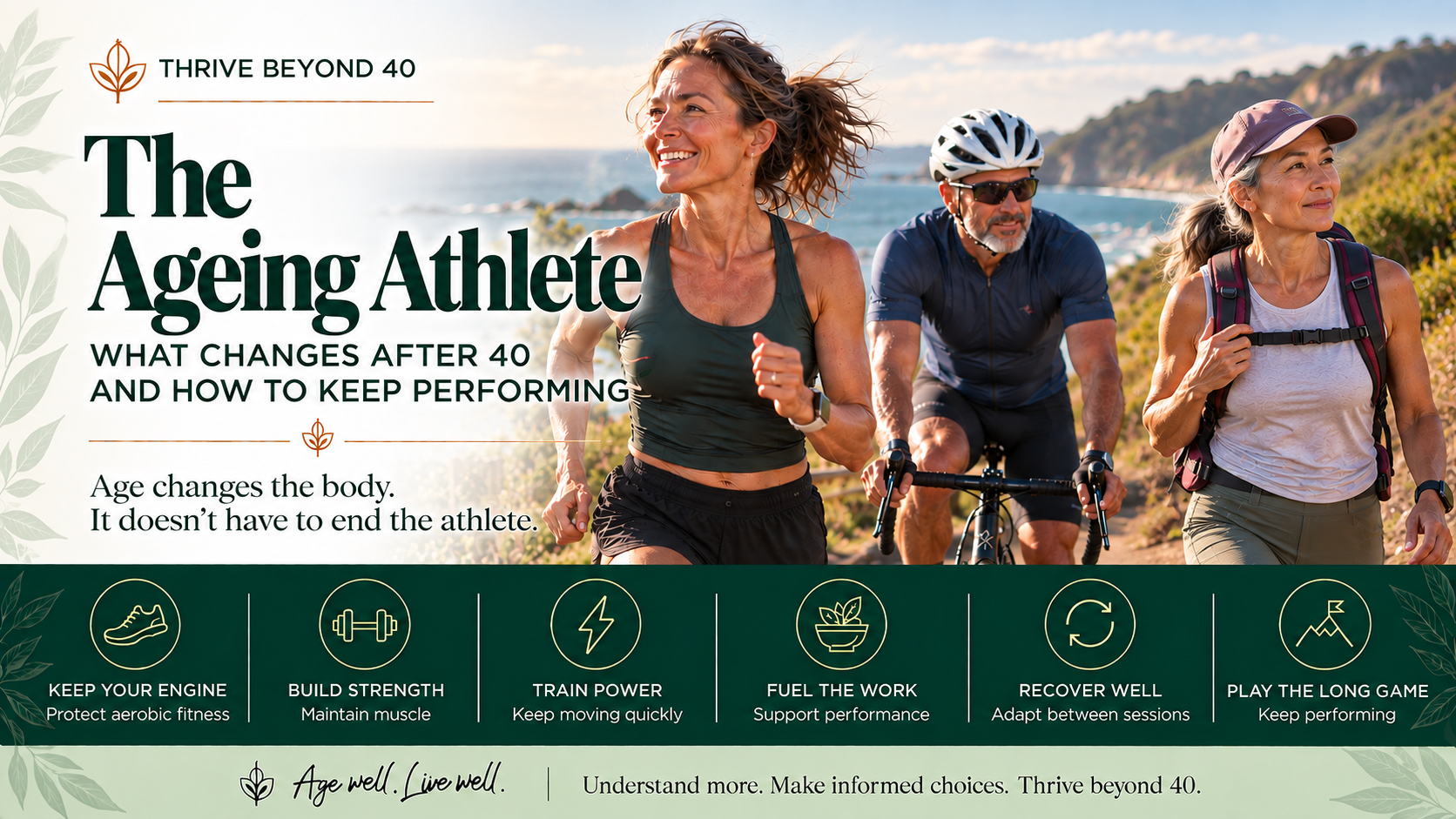
Age changes the body. It doesn’t have to end the athlete.
There is a point when you realise you're no longer the youngest person at the start line.
Or in the gym.
On the bike.
At training.
Perhaps recovery takes a little longer.
Your warm-up suddenly matters.
The niggle you once ignored hangs around.
Your maximum speed isn't quite what it used to be.
And staying strong requires more deliberate effort.
But something else may have happened too.
You're smarter.
More disciplined.
Better at pacing yourself.
More consistent.
Less interested in proving yourself in every training session.
And perhaps more appreciative than ever of what your body can do.
Being an athlete after 40 isn't about pretending you're still 25.
It's about discovering how well your body can perform now and how much capability you can carry into the decades ahead.
What actually changes as we age?
Ageing affects several systems involved in physical performance.
Over time, we can experience changes in:
Muscle mass.
Muscle strength and power.
Aerobic capacity.
Bone.
Connective tissues.
Recovery.
Balance and coordination.
Hormonal environment.
And the body's response to training.
But there's an important distinction.
Ageing and detraining are not the same thing.
Some of what people attribute to "getting older" can also reflect becoming less active.
Less running.
Less strength training.
More sitting.
Less sport.
Weight gain.
Poor sleep.
Busy careers.
Family responsibilities.
And years of gradually reducing physical challenge.
That's why comparing an active 50-year-old with a sedentary 25-year-old tells us very little about what ageing itself means.
You can remain remarkably capable
Look around any masters sporting event and you'll see it.
People in their 40s, 50s, 60s, 70s and beyond:
Running.
Swimming.
Cycling.
Rowing.
Lifting.
Competing.
Playing.
Some are lifelong athletes.
Others discovered sport later.
They aren't immune to ageing.
They've simply continued giving their bodies reasons to adapt.
That distinction matters.
Your body remains responsive to exercise well beyond your 40s.
You can still become stronger.
Improve fitness.
Learn new skills.
Build muscle.
Improve balance.
And increase physical capacity.
The rate and ceiling may change.
The ability to adapt doesn't disappear.
Aerobic capacity can decline, but training matters enormously
One of the most discussed changes in ageing athletes is aerobic capacity.
VO₂ max refers to the maximum amount of oxygen your body can use during intense exercise and is an important measure of cardiorespiratory fitness.
It tends to decline with age.
But the size and timing of that decline are influenced by physical activity and training.
An endurance-trained older adult can retain extraordinary cardiovascular fitness compared with inactive peers.
Age influences your potential.
Behaviour influences how much of it you retain.
That's an important difference.
You may lose top-end speed before endurance
Many athletes notice changes in explosive performance earlier than their ability to keep going.
Sprint speed.
Jumping.
Rapid changes of direction.
Maximum power.
These rely heavily on fast, powerful muscle contractions.
Power tends to become particularly important as we age because it isn't only relevant to sport.
Power is what allows you to react quickly.
Catch yourself.
Climb stairs efficiently.
Move your body rapidly when needed.
Don't only train to be strong.
Keep some speed and power in your life where it is appropriate and safe for you.
For one person, that might be sprint intervals.
For another, faster cycling efforts.
Medicine-ball throws.
Jumps.
Or simply moving a resistance more quickly under professional guidance.
The right approach depends on your experience and physical condition.
Muscle doesn't disappear because you turned 40
Age-related muscle loss is real.
But it isn't inevitable that every person becomes progressively weak.
Resistance training remains one of the most powerful tools available for maintaining and improving strength.
That's why strength needs to be part of the ageing athlete's program, even when strength isn't their primary sport.
If you're a runner, strength matters.
If you're a cyclist, strength matters.
If you're a swimmer, strength matters.
If you're a golfer, strength matters.
If you play team sport, strength matters.
Muscle is performance infrastructure.
And later in life, it becomes independence infrastructure too.
Our article Strength After 40 explores that bigger picture.
Don't forget the muscle you can't see in the mirror
Athletes often focus on visible muscle.
But performance relies on much more.
Glutes.
Hamstrings.
Calves.
Back.
Core musculature.
Grip.
Stabilisers.
The muscles supporting joints and movement patterns.
A balanced strength program isn't simply about looking athletic.
It should support the demands of your sport and your broader physical capability.
Train the body you use, not only the body you see.
Protein becomes part of maintaining the athlete
Training creates demand.
Nutrition helps support the response.
Protein contributes to the growth and maintenance of muscle mass, making adequate intake particularly relevant for active adults.
As we explored in Protein After 40, older muscle may become somewhat less responsive to protein's muscle-building stimulus, sometimes described as anabolic resistance.
That makes the combination of:
Resistance exercise + adequate protein
particularly valuable.
But athletes shouldn't become so focused on protein that they forget everything else.
Carbohydrate still matters
If you train hard, carbohydrate can be a valuable fuel.
Endurance sessions.
Intervals.
Competitive sport.
Long rides.
Hard runs.
High-intensity training.
All increase energy demands.
Some active adults unintentionally under-fuel because they're simultaneously trying to:
Lose weight.
Eat "clean".
Avoid carbohydrates.
Train frequently.
And improve performance.
Eventually those goals can start fighting each other.
You can't continually ask the body to produce high output while refusing to adequately fuel the work.
Your carbohydrate requirements depend on the volume and intensity of your training.
Not everyone needs an athlete's carbohydrate intake.
But athletes shouldn't fear a nutrient their training can actively use.
Energy availability matters
This is particularly important.
Your body needs enough energy not only to train but to support normal physiological functions.
When energy intake is persistently too low relative to exercise demands, health and performance can be affected.
This concept is relevant to both women and men.
Athletes may deliberately restrict food to change body composition.
Others simply become so busy that they don't realise they're under-fuelling.
Leaner isn't always better.
And lighter isn't automatically faster if the process compromises health, strength, recovery or performance.
If you are training heavily and experiencing persistent fatigue, recurrent injuries, menstrual changes, declining performance or other concerning symptoms, seek appropriate professional advice.
Women athletes have another transition to navigate
For many women, peak career, family responsibilities and serious recreational sport collide with perimenopause.
Sleep may change.
Temperature regulation may feel different.
Menstrual patterns change.
Body composition can shift.
Recovery may feel less predictable.
This doesn't mean exercise should stop.
Far from it.
But it may require a more flexible approach to training and recovery.
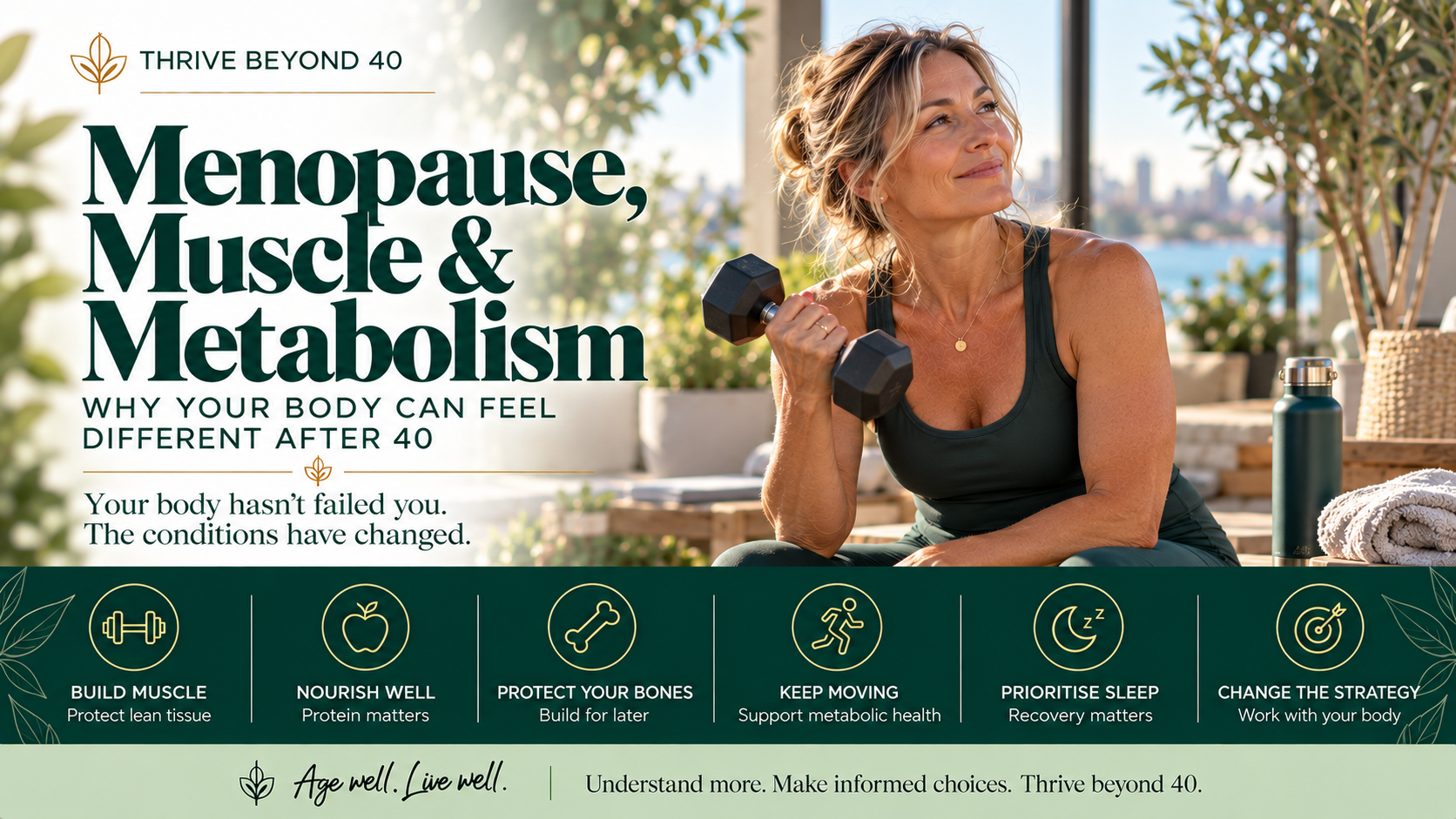
Our Menopause, Muscle & Metabolism article explores this in detail.
Your training plan should serve your body.
Your body doesn't exist to serve the spreadsheet.
Bone matters to athletes too
Athletes can appear incredibly healthy from the outside.
But high fitness doesn't automatically guarantee strong bones.
Bone health is influenced by numerous factors, including:
Age.
Sex.
Hormonal status.
Nutrition.
Energy availability.
Genetics.
And the type of physical loading your body receives.
Weight-bearing and resistance exercise can provide valuable loading for bone.
Some sports provide more skeletal loading than others.
Cycling and swimming, for example, offer enormous cardiovascular benefits but provide less weight-bearing impact than activities such as running.
That doesn't make them inferior sports.
It means your training program may need to fill the gaps your sport leaves behind.
Our Bone Health After 40 article explores those foundations further.
Connective tissues deserve respect
Muscles aren't the only tissues being loaded.
Tendons.
Ligaments.
Cartilage.
Fascia.
And other connective tissues all contribute to movement.
Adaptation takes time.
That's particularly relevant when someone discovers a new sport at 45 and becomes very enthusiastic very quickly.
Your cardiovascular system may feel capable of doing more before other tissues are ready for the same workload.
Fitness can improve faster than your tissues tolerate training load.
Progress gradually.
Give the body time to adapt.
And don't interpret every rest day as lost progress.
Collagen is part of the structural conversation
Collagen is a major structural protein in connective tissues.
Your body produces collagen naturally, but collagen production and tissue characteristics change with age.
Adequate overall nutrition remains the foundation.
Protein.
Vitamin C.
Micronutrients.
Sufficient energy.
And appropriately programmed exercise all matter.
Targeted collagen nutrition can sit alongside those foundations for people who choose to use it.
But collagen isn't a substitute for training intelligently.
You cannot supplement your way out of excessive training load.
Our Collagen After 40 article explores collagen beyond its better-known role in skin.
Recovery becomes training
When you're young, recovery can feel like the absence of training.
Later, you begin to understand that it is part of training.
Sleep.
Food.
Hydration.
Easy days.
Rest days.
Appropriate training load.
Physiotherapy when needed.
Mobility where useful.
And simply giving the body enough time between demanding sessions.
This doesn't mean treating yourself as fragile.
It means respecting adaptation.
The goal is not to avoid stress.
Training requires stress.
The goal is to apply enough stress to stimulate adaptation without continually exceeding your ability to recover from it.
Sleep becomes increasingly difficult to fake
A poor night's sleep occasionally isn't going to destroy your fitness.
But chronic sleep restriction is different.
Sleep supports physical and cognitive recovery.
It also influences mood, appetite, decision-making and how training feels.
If you're training hard while consistently sleeping five hours a night, the solution may not be another recovery supplement.
Start with the foundation.
Our Sleep After 40 article explores why recovery deserves more attention as we age.
Omega-3 and the active adult
Omega-3 nutrition is another area receiving considerable attention in sport and healthy ageing.
The long-chain omega-3 fatty acids EPA and DHA have recognised physiological roles, including contributing to normal heart function at appropriate intakes, while DHA contributes to normal brain function.
Oily fish remains an excellent dietary source.
At Thrive Beyond 40, we take a personalised approach to fatty-acid nutrition through our Balance Program, which uses an at-home fatty-acid test followed by targeted nutritional support and retesting.
But it's important not to turn omega-3 into an athletic-performance miracle.
There is no single nutrient that replaces training, recovery and good overall nutrition.
Later in this Performance & Longevity series, we'll look specifically at what the research around omega-3 and active adults actually tells us.
Your warm-up may suddenly make sense
Remember when warming up felt optional?
Then somewhere along the way, it stopped feeling optional.
That's not necessarily a bad thing.
A good warm-up can gradually increase:
Body temperature.
Blood flow.
Movement preparation.
And readiness for the demands of the session.
It also creates an opportunity to notice how your body feels that day.
Stiff?
Energetic?
Sore?
Ready?
A warm-up isn't evidence that you're old.
It's evidence that you've become sensible.
Don't make every training session a test
This becomes increasingly important for competitive personalities.
Not every run needs to prove your fitness.
Not every ride needs a personal best.
Not every gym session requires a maximum lift.
Not every training partner needs to be beaten.
Training and testing are different things.
Training builds fitness.
Testing demonstrates it.
If you're constantly testing yourself, you may spend too little time actually building.
Easy needs to be easy
This sounds simple.
It isn't.
Particularly when you love training.
An easy run gradually becomes moderate.
A recovery ride becomes a group race.
A light gym session becomes heavy.
And suddenly every day sits somewhere in the middle.
Well-designed training benefits from variation.
Hard days can be hard.
Easy days can genuinely be easy.
And sometimes you rest.
Recovery isn't something you earn after exhaustion.
It's something you plan so exhaustion doesn't become the strategy.
Injury prevention isn't about never getting injured
Sport carries risk.
You cannot eliminate every injury.
But you can reduce unnecessary risk.
Progress training loads gradually.
Maintain strength.
Allow recovery.
Use appropriate technique.
Address persistent pain.
Fuel appropriately.
Sleep.
Choose equipment suitable for your activity.
And don't let ego decide your training load.
If something hurts persistently, changes your movement or keeps returning, get it assessed.
"I'm just getting old" isn't a diagnosis.
Sometimes something simply needs attention.
Your competitive advantage may become consistency
When you're younger, you can sometimes get away with extremes.
Train incredibly hard.
Recover badly.
Disappear for a month.
Return.
Repeat.
After 40, consistency becomes increasingly valuable.
Three sensible months can beat three heroic weeks followed by injury.
One year of progressive strength training can beat repeated six-week fitness kicks.
Regular sleep beats one recovery weekend.
Good everyday nutrition beats occasional perfection.
The athlete who keeps showing up has an enormous advantage.
Your performance metrics may evolve
At 25, success might have meant:
Fastest time.
Heaviest lift.
Highest ranking.
Winning.
At 50, perhaps those things still matter.
Great.
But you may add other measures.
How consistently can I train?
How well am I recovering?
Am I still getting stronger?
Can I stay injury-free enough to enjoy my sport?
Can I maintain fitness year after year?
Can I compete at 60?
At 70?
Longevity changes the scoreboard.
Performance today matters.
But so does the ability to keep performing.
Masters sport changes what ageing looks like
There is something culturally important about older athletes.
They challenge the assumption that ageing automatically means withdrawal.
They show younger people another version of later life.
Strong.
Competitive.
Capable.
Social.
Adventurous.
Engaged.
That doesn't mean denying ageing.
Quite the opposite.
It means working with ageing instead of surrendering to it.
You don't have to call yourself an athlete
Maybe you don't compete.
Maybe you've never stood on a podium.
Perhaps your "sport" is Saturday cycling.
Parkrun.
Golf.
Tennis.
Ocean swimming.
Gym training.
Surfing.
Hiking.
Running with friends.
You still have performance goals.
You still ask your body to adapt.
You still need to recover.
Athlete isn't only a job title.
Sometimes it's simply an identity built around continuing to move.
Keep something challenging in your life
Healthy ageing shouldn't only be about avoiding decline.
There is value in pursuing something.
A faster 5 km.
A heavier deadlift.
A cycling event.
A hiking trip.
A new sport.
A masters competition.
A swim across the bay.
A first pull-up.
Goals give training direction.
They can also give us community, confidence and purpose.
Don't only exercise because ageing is something you're afraid of.
Train because there are still things you want to do.
Become a smarter athlete, not a younger one
You don't need to win an argument with ageing.
You need to build a relationship with the body you have now.
Train it.
Fuel it.
Challenge it.
Strengthen it.
Let it recover.
Pay attention when something changes.
Use health information where it adds value.
Seek qualified help when you need it.
And keep setting goals that make you excited to move.
Your fastest days may or may not be behind you.
Your strongest may not be.
Your most adventurous certainly don't have to be.
Age changes the body.
It doesn't have to end the athlete.
Keep training.
Keep adapting.
Keep competing, if that's what you love.
Keep doing more of the life your fitness makes possible.
Age Well. Live Well.
Ready to play the long game?
Don't train to stay young. Train to stay capable.
Performance and longevity aren't competing goals.
Train intelligently, build strength, fuel appropriately and give your body the recovery it needs to keep doing more of what you love
Continue exploring
Performance After 40: How to Keep Training Hard Without Ignoring Recovery →
Protein After 40: How Much Do You Really Need? →
Strength After 40: Why Muscle Is One of Your Best Investments in Healthy Ageing →
Recovery After 40: Why Your Body Needs a Different Approach →
Keywords: ageing athlete, athlete over 40, athletes over 40, masters athlete, training after 40, sports performance after 40, fitness after 40, ageing and athletic performance, exercise recovery after 40, masters athlete training, active ageing
Category: Performance & Longevity