By
By
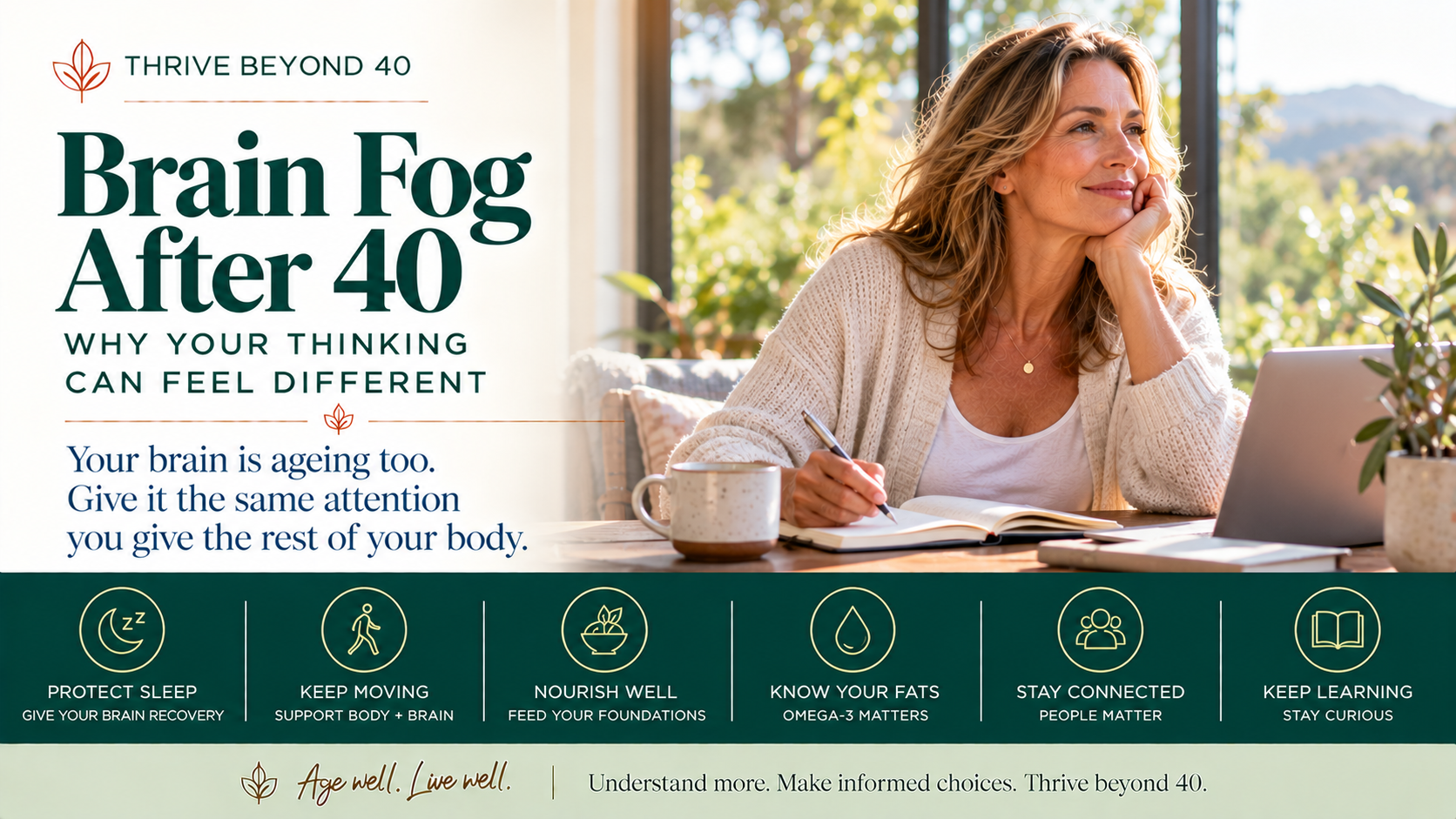
Walking into a room and forgetting why you're there? You're not alone.
You know the word.
You've used it hundreds of times.
It's right there.
But suddenly, you can't find it.
Or perhaps you've opened your laptop and forgotten what you were about to do.
You're halfway through a sentence and your train of thought disappears.
You reread the same paragraph three times.
Names take longer to retrieve.
Concentration feels harder.
And on particularly busy days, your brain seems to have 47 tabs open and no idea where the music is coming from.
Welcome to what many of us casually call:
Brain fog.
It's not a medical diagnosis.
But the experience can be very real.
And for many women, it becomes particularly noticeable during their 40s and 50s.
The reassuring part is that feeling mentally foggy doesn't automatically mean something is wrong with your brain.
There can be many contributors.
Hormonal change.
Sleep.
Stress.
Mental load.
Nutrition.
Physical activity.
And sometimes, simply trying to fit far too much into one human brain.
Understanding those influences can help us think about brain health differently.
Because healthy ageing isn't only about keeping our bodies strong.
We want our brains coming with us too.
What does "brain fog" actually feel like?
Brain fog means different things to different people.
Common experiences include:
Difficulty concentrating
You sit down to complete something but find it harder to stay focused.
Forgetfulness
Appointments, names or why you walked into the pantry suddenly disappear.
Word-finding difficulty
You know exactly what you want to say, but retrieving the word takes longer.
Mental fatigue
Your brain feels tired even when your body isn't.
Slower thinking
Processing information or switching between tasks may feel less effortless than it once did.
These experiences can be frustrating, particularly if you've always thought of yourself as organised, sharp or good at juggling multiple things.
But rather than immediately thinking:
"What's wrong with my memory?"
there's another question worth asking.
What else is happening in my life and body right now?
Perimenopause can be part of the picture
For women over 40, this is an important place to start.
The menopausal transition involves changing levels of hormones including oestrogen.
And the brain isn't separate from those hormonal changes.
Research into menopause and cognition has found that some women report changes in memory, attention, processing speed and word retrieval during the menopausal transition.
That doesn't mean every forgotten name is caused by perimenopause.
And it certainly doesn't mean your brain is suddenly deteriorating.
But it does mean that cognitive changes deserve a place in the conversation about menopause.
Hot flushes get talked about.
Periods get talked about.
Mood gets talked about.
Brain fog deserves to be talked about too.
Your hormones may not be acting alone
One reason brain fog can feel so complicated during perimenopause is that several things may be happening at once.
Hormonal changes.
Poorer sleep.
Night sweats.
Work pressure.
Children.
Teenagers.
Young children.
Ageing parents.
Relationships.
Appointments.
Household administration.
Career responsibilities.
And the endless invisible list of things that need remembering.
Sometimes the brain isn't failing.
It's overloaded.
That's an important distinction.
We can be very quick to blame ourselves for becoming forgetful when our cognitive workload has quietly become enormous.
Sleep and brain fog are closely connected
If I were looking at brain fog, sleep would be one of the first foundations I'd consider.
Sleep is not simply the time when you're unconscious.
It's an essential biological process involved in memory, learning, emotional regulation, metabolism and recovery.
And unfortunately, sleep can become more disrupted during midlife.
You may have difficulty falling asleep.
Wake during the night.
Wake too early.
Experience night sweats.
Have a child climb into your bed.
Or lie awake mentally writing tomorrow's to-do list.
Then morning arrives and we wonder why our brain isn't firing perfectly.
Sometimes brain fog is an exhausted brain asking for recovery.
That doesn't mean every cognitive symptom can be fixed with more sleep.
But sleep is too important to ignore.
Stop treating recovery as optional
We're very good at celebrating productivity.
Get up early.
Work harder.
Exercise.
Look after everyone.
Build the career.
Run the household.
Stay social.
Stay healthy.
Keep going.
And then somehow fit eight hours of beautiful restorative sleep into whatever is left.
Healthy ageing asks us to think differently.
Recovery isn't what you do when you've finished everything else.
It's part of maintaining the system that allows you to do everything else.
That includes your brain.
Stress can make thinking harder
Think about how your brain feels when you're relaxed on holiday compared with a morning when you're running late, answering messages, looking for someone's shoes and mentally rehearsing a work meeting.
Same brain.
Very different conditions.
Stress can affect attention, memory and our ability to retrieve information efficiently.
And chronic stress can also disrupt sleep, which adds another layer.
The answer isn't necessarily to "eliminate stress".
That's not realistic.
Instead, create more opportunities for your nervous system and brain to come out of constant demand.
Walk.
Exercise.
Get outside.
Talk to someone.
Take a proper lunch break.
Read.
Garden.
Sit quietly.
Laugh.
Do something you enjoy without trying to turn it into a health optimisation exercise.
Your brain needs space too.
Movement is brain health
We often exercise because we're thinking about:
Weight.
Muscle.
Bones.
Heart health.
Fitness.
But physical activity is also one of the important foundations of brain health.
Your brain depends on the health of the body supporting it.
Cardiovascular health matters.
Blood pressure matters.
Metabolic health matters.
Movement matters.
And resistance training gives us another reason to maintain muscle and physical capability as we age.
So don't think of exercise as something you do purely to change how your body looks.
Move for the brain you're taking into your 60s, 70s and beyond.
Walk.
Lift weights.
Swim.
Cycle.
Dance.
Hike.
Play sport.
Garden.
Choose something you'll actually continue doing.
Consistency matters more than finding the perfect exercise.
Your brain needs nourishment too
There's no single "brain food" that guarantees cognitive health.
But the brain is an extraordinarily metabolically active organ, and good nutrition matters.
A strong nutritional foundation includes:
Plenty of vegetables and fruit.
Wholegrains.
Legumes.
Nuts and seeds.
Adequate protein.
Healthy fats.
Fish and seafood where appropriate.
And enough fibre to support broader metabolic and gut health.
Again, the pattern matters more than one superfood.
Blueberries are lovely.
Walnuts are nutritious.
Salmon is an excellent food.
But adding blueberries to an otherwise poor diet doesn't create a brain-health strategy.
Build the pattern.
Omega-3 has a particularly interesting connection to the brain
One nutrient I do think deserves specific attention is omega-3, particularly DHA.
DHA is an important structural fatty acid in the brain and contributes to the maintenance of normal brain function.
EPA and DHA are found predominantly in marine sources such as oily fish.
This doesn't mean taking omega-3 will magically clear brain fog.
That's far too simplistic.
But if we're thinking about the nutritional foundations of healthy ageing, ensuring adequate long-chain omega-3 intake makes sense.
And this is where I like moving beyond assumptions.
Are you actually getting enough omega-3?
You might eat salmon.
Take fish oil.
Or consider your diet generally healthy.
But that doesn't necessarily tell you your fatty-acid status.
Through the BalanceTest, we can analyse a person's fatty-acid profile, including markers such as the Omega-3 Index and Omega-6:3 Balance.
That's useful because it changes the conversation from:
"Omega-3 is good for the brain, so I should probably take some."
to:
"What does my own fatty-acid profile look like?"
Then you can make a more informed decision about whether targeted nutritional support has a place.
That's the philosophy behind the Thrive Beyond 40 Balance Program:
TEST → UNDERSTAND → SUPPORT → RETEST
Not because every aspect of health needs measuring.
But because where meaningful information is available, it can help us make more personalised choices.
Heart health and brain health aren't separate conversations
We often divide the body into categories.
Heart health.
Brain health.
Gut health.
Bone health.
But your body doesn't operate in departments.
The brain requires a healthy blood supply.
That's one reason cardiovascular risk factors such as high blood pressure, smoking, diabetes and physical inactivity matter when we think about long-term brain health.
Taking care of your heart is also part of taking care of your brain.
And this becomes increasingly important after 40.
Don't wait until your 70s to start thinking about cognitive health.
The brain you're ageing with is the brain you're supporting today.
Keep learning
Your brain likes being used.
That doesn't mean you need to start doing complicated puzzles every morning because someone told you they're good for your brain.
Learn because learning makes life interesting.
Read something outside your usual interests.
Learn a language.
Take a course.
Cook something new.
Travel somewhere unfamiliar.
Learn to play an instrument.
Try a new sport.
Change careers.
Build something.
Ask questions.
Stay curious.
Healthy ageing isn't simply about preserving what we have.
It's about continuing to grow.
Stay connected
This may be one of the most underestimated parts of healthy ageing.
Humans are social.
Conversation challenges the brain.
Relationships give us emotional support.
Other people expose us to different ideas and experiences.
And social connection is consistently associated with health and wellbeing as we age.
Call the friend.
Have dinner together.
Join the group.
Talk to your neighbours.
Spend time with family.
Laugh.
Share stories.
Be part of something.
We can spend enormous amounts of money trying to optimise longevity while overlooking one of the most human parts of living well.
Other people matter.
Don't overlook hearing and vision
This might seem unrelated to brain fog, but sensory health belongs in the broader cognitive-health conversation.
If you're struggling to hear conversations or see clearly, your brain has to work harder to interpret the world around you.
Hearing and vision checks are simple parts of proactive healthcare that can become increasingly important as we age.
Healthy ageing isn't always about sophisticated tests.
Sometimes it's about attending the appointments we've been putting off.
What about supplements for brain fog?
This is where I become cautious.
The wellness market is full of products promising:
Sharper thinking.
Better memory.
Mental clarity.
Focus.
Brain optimisation.
But brain fog can have many possible contributors.
So before building a cupboard full of "brain supplements", start with the bigger picture.
How are you sleeping?
Are you moving?
Are you eating well?
Are you getting enough omega-3?
Are you drinking heavily?
Are you constantly stressed?
Could perimenopause be contributing?
Are you taking medications that may affect cognition?
Could there be an underlying nutritional or medical issue?
Understand before you add.
That's a much more useful approach.
When should brain fog be checked medically?
Everyday forgetfulness is one thing.
But new, significant or worsening cognitive changes deserve proper medical attention.
Speak with your GP or an appropriate healthcare professional if memory or thinking changes are:
Persistent.
Getting noticeably worse.
Interfering with work or everyday activities.
Affecting your ability to manage familiar tasks.
Accompanied by significant mood or neurological changes.
Or simply worrying you.
There can be many causes of cognitive symptoms, including medical conditions, medication effects, nutritional deficiencies, sleep disorders, depression and anxiety, thyroid problems and other factors.
And sudden confusion or sudden neurological symptoms require urgent medical attention.
Don't diagnose significant cognitive changes as "just menopause".
Get them properly assessed.
Brain fog doesn't define your future brain
This is perhaps the most important message in this article.
If you've found yourself forgetting words or feeling mentally slower during your 40s or 50s, don't immediately turn that experience into a story about decline.
Your brain exists within a changing body and a changing life.
Hormones may be shifting.
Sleep may be disrupted.
Responsibilities may have multiplied.
Stress may be higher.
And your health foundations may need more attention than they did at 25.
That's information.
Not a verdict.
Give your brain the same attention you give your body
We spend a lot of time thinking about how ageing looks.
Our skin.
Hair.
Weight.
Muscle tone.
Wrinkles.
But healthy ageing is also about how ageing feels and functions.
Can I think clearly?
Can I keep learning?
Can I make decisions?
Can I stay engaged?
Can I work if I want to?
Can I travel?
Can I have great conversations?
Can I remain independent?
Can I continue being curious about the world?
Those are healthy-ageing goals too.
Healthy ageing includes your brain.
So build the foundations now.
Move your body.
Build strength.
Protect your sleep.
Nourish your brain.
Know the health numbers that matter.
Stay connected.
Keep learning.
And don't become so focused on preserving your brain that you forget to fill it with memories worth keeping.
Health is the foundation. Life is the point.
Age Well. Live Well.
Ready to think differently about healthy ageing?
Support the brain you're taking into the years ahead.
Thrive Beyond 40 brings together evidence-informed health education, personalised insights and practical nutritional and lifestyle foundations to help you take a more proactive approach to ageing well.
Understand more.
Make informed choices.
Keep building.
Continue exploring
Omega-3 After 40: What You Need to Know →
Sleep After 40: Why Recovery Matters More Than You Think →
Perimenopause and Healthy Ageing: Looking Beyond the Symptoms →
Heart Health After 40: The Foundations Worth Paying Attention To →
Keywords: brain fog after 40, brain fog perimenopause, brain health after 40, cognitive health, menopause brain fog, sleep and brain health, omega-3 brain health, healthy ageing
Category: Brain, Sleep & Wellbeing