By
By
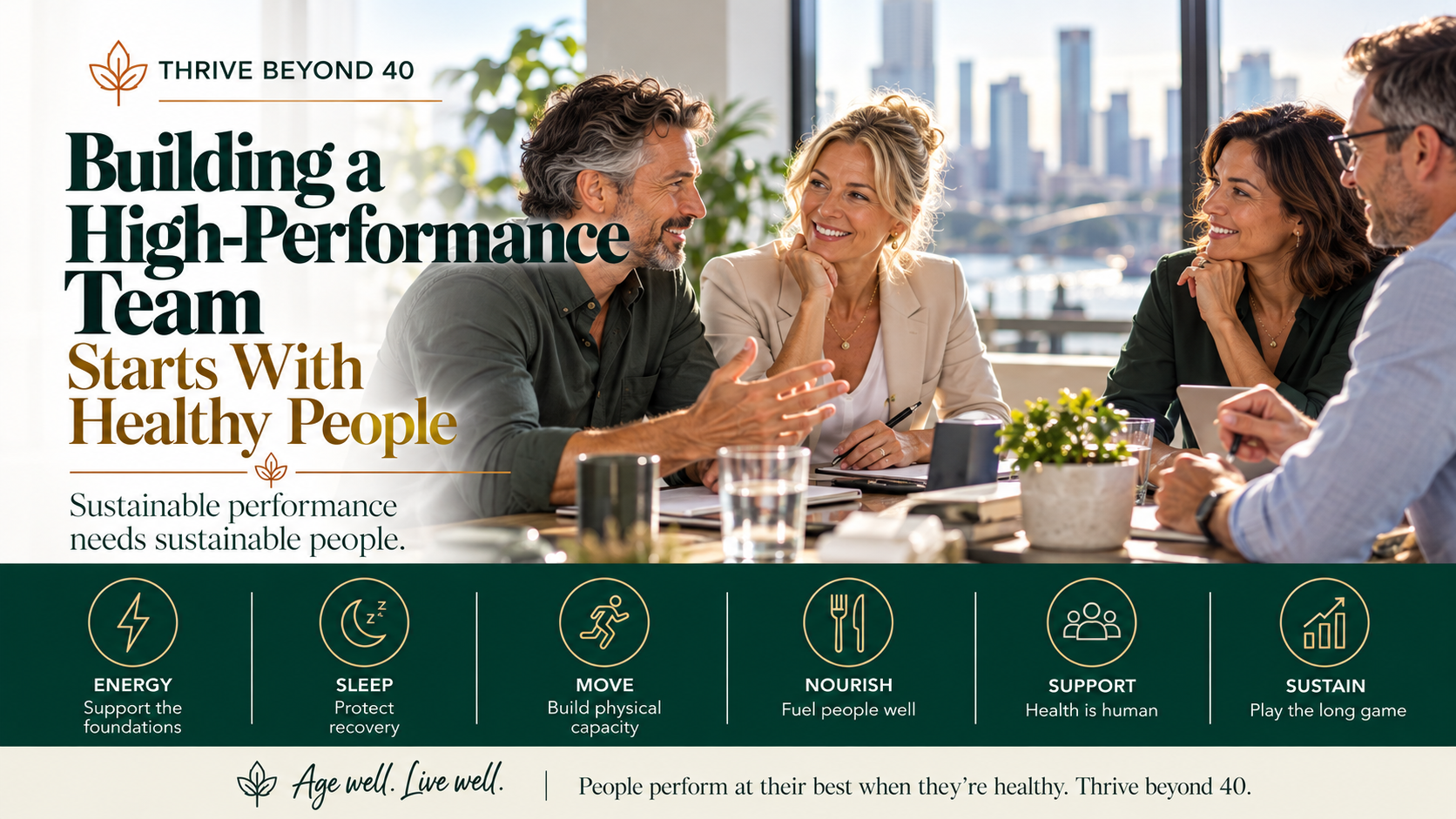
Performance isn’t just about what people can produce. It’s about whether they have the capacity to keep producing it.
Every organisation wants high performance.
More energy.
Better thinking.
Stronger leadership.
Greater productivity.
Resilience.
Engagement.
People who can perform under pressure and still deliver when things get difficult.
But there’s an obvious part of that equation we don’t always talk about:
The people doing the performing have bodies and brains.
They need sleep.
They need nourishment.
They need movement.
They need recovery.
They experience stress.
They have families.
They get older.
They experience health challenges.
And no amount of performance strategy changes that.
Whether we’re talking about an executive team, a small business, a professional services firm or a sporting organisation, sustainable performance ultimately depends on the capacity of the people within it.
Healthy people don’t automatically create high-performing teams.
But poor health can make sustained high performance considerably harder.
The old model of high performance is wearing thin
For a long time, high performance was associated with pushing harder.
Longer hours.
More training.
More meetings.
More output.
More availability.
Less sleep.
Less recovery.
And an ability to keep going regardless of the cost.
Sometimes that works.
For a while.
But there is a difference between high output and sustainable high performance.
Anyone can have an intense week.
An organisation can push through a demanding quarter.
An athlete can survive a brutal training block.
The harder question is whether people can keep performing well without continually borrowing from their health.
That’s where the conversation becomes much more interesting.
Your people are not separate from their health
Someone doesn’t leave their physiology at the office door.
The executive presenting to the board may also have slept for five hours.
The manager making complex decisions may have skipped lunch.
The employee struggling to concentrate may be experiencing perimenopause.
The business owner working late every night may have high blood pressure they don’t know about.
The athlete expected to perform may also be under-fuelled and poorly recovered.
The team member who seems disengaged may be experiencing significant stress outside work.
Performance happens inside real human beings.
Understanding that isn’t being soft on performance.
It’s being realistic about where performance comes from.
Energy matters
When people talk about workplace energy, they often mean motivation.
But there is also physical energy.
People need sufficient nutrition.
Sleep.
Movement.
Recovery.
And appropriate healthcare.
Persistent fatigue can have many causes and deserves appropriate investigation.
But everyday habits also matter.
If someone regularly skips meals, lives on takeaway, drinks heavily, sleeps poorly, rarely moves and works late into the evening, it’s unsurprising if they don’t consistently feel or perform at their best.
You can’t build sustainable performance entirely through motivation.
The body still needs resources.
Sleep is a performance strategy
Sleep is often one of the first things high performers sacrifice.
One more email.
One more episode.
One more hour of work.
An early flight.
A late client dinner.
A 5am training session after a midnight bedtime.
Individually, these may not matter much.
Repeatedly, they can.
Sleep affects attention, reaction time, learning, memory, mood and decision-making.
For organisations relying heavily on people’s brains, that makes sleep relevant to performance.
An exhausted brain is still expected to make important decisions.
That deserves more attention than it often receives.
Our Sleep After 40 article explores why recovery becomes increasingly important as we age.
Nutrition affects the working day too
Workplace nutrition discussions can become painfully predictable.
Fruit bowls.
Healthy snacks.
Salad at the corporate wellness day.
But nutrition is more fundamental than that.
Food provides:
Energy.
Protein.
Fatty acids.
Carbohydrate.
Fibre.
Vitamins.
Minerals.
And countless other compounds used throughout the body.
What people eat across months and years also contributes to broader cardiovascular, metabolic and general health.
Nutrition isn’t an employee perk.
It’s part of being human.
Organisations don’t need to tell people exactly what to eat.
But they can create environments where looking after yourself isn’t made unnecessarily difficult.
At Thrive Beyond 40, we also look at nutrition through several different lenses.
Our Balance Program uses fatty-acid testing to help people understand their omega-3 and broader fatty-acid profile.
Gut Foundations focuses on strengthening daily fibre nutrition alongside a varied, whole-food diet.
And Collagen Renewal takes a targeted approach to collagen nutrition within the bigger picture of healthy ageing, strength, movement and looking after the body as it changes over time.
None of these replaces the foundations of a nutritious diet.
They simply provide different ways of understanding and supporting those foundations.
The lunch-break test
Want a simple insight into workplace health culture?
Look at lunch.
Do people actually take a break?
Can they step away from their desk?
Is eating while answering email normal?
Are meetings routinely booked through lunch?
Is leaving the office for 20 minutes interpreted as lack of commitment?
You can give employees a wellbeing app.
But if the culture makes taking a proper break feel impossible, the app isn’t addressing the underlying problem.
Culture often communicates louder than wellness initiatives.
Movement matters when work becomes sedentary
Many high-performing professionals spend enormous amounts of time sitting.
Desk.
Car.
Plane.
Meeting room.
Restaurant.
Sofa.
Repeat.
A workout is valuable.
But movement throughout the day matters too.
Walk to a meeting.
Take the stairs.
Stand up.
Go outside at lunch.
Walk while taking a call when appropriate.
Encourage genuine breaks between long periods of concentrated work.
The human body wasn’t designed to spend an entire working life in a chair.
Organisations don’t need to turn the office into a gym.
They simply need to stop making movement feel incompatible with productivity.
Strength is a workplace issue too
At first glance, strength training seems to have little to do with business.
But zoom out.
The experienced people in your organisation are ageing.
The 42-year-old executive becomes 52.
Then 62.
Muscle mass and strength matter increasingly as we age.
Strength supports:
Physical capability.
Metabolic health.
Mobility.
Bone health.
Confidence.
And independence.
Healthy ageing is already happening inside your workforce.
The question is whether anyone is paying attention to it.
Midlife deserves particular attention
Many workplaces are led by people in their 40s, 50s and 60s.
These can be enormously productive years.
Experience.
Judgement.
Networks.
Leadership.
Confidence.
Expertise.
But they’re also years when health can begin changing.
Blood pressure.
Cholesterol.
Blood glucose.
Body composition.
Sleep.
Muscle.
Bone health.
Recovery.
And for women, perimenopause and menopause.
Midlife health isn’t a niche workplace issue.
It’s part of maintaining the capability of experienced people.
Women shouldn’t have to hide menopause at work
Perimenopause can affect women very differently.
Some experience relatively few symptoms.
Others may experience:
Sleep disruption.
Hot flushes.
Changes in mood.
Brain fog.
Fatigue.
Changes in body composition.
Or other symptoms that affect how they feel and function.
This doesn’t mean women become less capable in midlife.
Far from it.
But workplaces benefit from understanding that menopause exists rather than expecting women to quietly manage everything behind the scenes.
Support doesn’t require lowering expectations.
Sometimes it simply requires better understanding.
Men shouldn’t wait for a health scare either
Men can also move through their 40s and 50s feeling reasonably well while important health markers begin changing quietly.
Blood pressure.
Blood glucose.
Blood lipids.
Waist circumference.
Sleep.
Fitness.
Muscle.
And other aspects of preventive health.
Busy men can be particularly good at postponing health appointments because nothing feels urgently wrong.
Feeling fine isn’t the same as knowing everything is fine.
Our Healthy Ageing for Men article explores this in more detail.
Mental wellbeing belongs in the performance conversation
A high-performing team still contains people experiencing:
Stress.
Anxiety.
Grief.
Relationship problems.
Parenting pressures.
Caring responsibilities.
Financial worries.
Trauma.
Burnout.
And mental health conditions.
Organisations aren’t expected to become psychologists.
Nor should managers try to diagnose people.
But psychologically safe workplaces, appropriate professional support and cultures where people can ask for help matter.
Performance and humanity don’t have to be opposing ideas.
People can be accountable and supported.
Ambitious and healthy.
Driven and capable of recovery.
Recovery isn’t laziness
This is especially important in cultures that celebrate intensity.
Recovery isn’t what happens when you’re not serious about performance.
It’s part of performance.
Athletes understand this better than many businesses do.
Training provides a stimulus.
Recovery provides the opportunity to adapt.
Business doesn’t work in exactly the same way, but the principle is useful.
Continuous demand without adequate recovery eventually has consequences.
More pressure isn’t always more performance.
Our Recovery for High Performers article explores this idea in much greater depth.
Leaders set the health culture whether they mean to or not
Imagine a CEO who says:
“I want everyone to look after their wellbeing.”
Then sends emails at 11:45pm.
Never takes annual leave.
Works while sick.
Books meetings through lunch.
And praises people for working weekends.
Which message does the team believe?
The wellbeing statement?
Or the behaviour?
People watch what leaders reward.
Leaders don’t need to become wellness influencers.
But their behaviour helps define what is considered normal.
High performance needs boundaries
Boundaries aren’t necessarily barriers to productivity.
They can protect the conditions that allow people to continue performing.
Clear expectations around availability, after-hours communication, leave, workload, meeting culture and recovery can help reduce unnecessary pressure.
That doesn’t mean nobody ever works late.
High-performance environments will sometimes require intense periods.
The difference is whether intensity is a season or the permanent operating model.
Preventive health deserves more attention
Traditional workplace wellbeing often focuses on what people feel.
Stress.
Energy.
Mood.
Engagement.
Those matter.
But some important health changes don’t necessarily produce obvious symptoms.
High blood pressure is an obvious example.
So are some changes in:
Blood glucose.
Blood lipids.
Body composition.
And other health markers.
This is why preventive healthcare matters.
You don’t need to feel unwell to have health worth paying attention to.
That principle sits at the centre of Thrive Beyond 40.
What about nutritional testing?
This is an area where organisations need to be thoughtful.
Personal health information should remain personal.
Employers should not need access to an individual’s nutritional test results.
Nor should employees feel pressured to participate in testing because their workplace offers it.
But voluntary health education and individual testing can give interested people an opportunity to understand more about their own nutrition.
This is the approach behind our Balance Program, which begins with an at-home fatty-acid test rather than simply recommending omega-3 without understanding someone’s starting point.
The test provides information about an individual’s fatty-acid profile, including their Omega-3 Index and specific AA:EPA balance.
Nutritional support is then followed by retesting, creating a simple framework:
TEST → UNDERSTAND → SUPPORT → RETEST
For workplaces or teams, the principle remains the same.
Participation should be voluntary.
Results remain personal.
And individual health information belongs to the individual.
Health data should never become performance data
This deserves to be explicit.
If organisations introduce testing or health initiatives, personal health information should not become another metric on the employee dashboard.
It shouldn’t be used to:
Rank people.
Assess promotion potential.
Evaluate commitment.
Compare teams.
Or make assumptions about someone’s future health.
Health information should empower the individual, not increase surveillance.
That principle becomes increasingly important as wearable technology and personal health data become more sophisticated.
Sporting organisations face a similar challenge
Sports teams already live in a data-rich environment.
Training load.
Heart rate.
GPS.
Power.
Speed.
Body composition.
Recovery scores.
Nutrition.
Performance.
But more data doesn’t automatically produce healthier athletes.
Athletes still need:
Adequate energy.
Protein.
Carbohydrate.
Healthy fats.
Sleep.
Recovery.
Mental health support.
Appropriate medical care.
And time away from training.
Performance data should serve the athlete.
The athlete shouldn’t exist to feed the performance dashboard.
That principle works in business too.
Don’t turn wellbeing into another thing people can fail at
This is a common mistake.
Drink more water.
Meditate.
Sleep eight hours.
Meal prep.
Lift weights.
Journal.
Stretch.
Take supplements.
Practise gratitude.
And somehow fit all of that around work and family.
Suddenly wellness becomes another performance target.
Health shouldn’t become another source of guilt.
A good workplace health strategy creates opportunity and education.
It doesn’t demand perfection.
Education can be surprisingly powerful
One of the simplest things an organisation can offer is better information.
Not another challenge.
Not another leaderboard.
Education.
Why does muscle matter after 40?
What is metabolic health?
Why does sleep matter?
What changes through menopause?
What does omega-3 actually do?
Why does fibre matter?
What role can collagen nutrition play as we age?
What health numbers are worth knowing?
What does recovery really mean?
Understanding changes behaviour differently from instruction.
People are much more likely to care about a health behaviour when they understand why it matters to their own future.
Make health personally relevant
Telling a 45-year-old executive:
“You should exercise because exercise is healthy.”
probably adds nothing.
They know.
But ask:
What do you want to be physically capable of at 60?
That’s different.
Travel?
Ski?
Hike?
Play sport?
Keep working?
Carry grandchildren?
Run a business?
Retire with energy?
Health becomes more compelling when it connects with someone’s life.
That’s one of the central ideas behind Thrive Beyond 40.
Health is the foundation. Life is the point.
Start with a healthier definition of performance
A high-performing team isn’t simply a group of people producing maximum output today.
A better definition might be:
People with the capacity to perform well, recover well and keep contributing over time.
That requires:
Good leadership.
Clear priorities.
Appropriate workloads.
Psychological safety.
Professional support where needed.
And a culture that recognises that human health influences human performance.
What can organisations actually do?
You don’t need an enormous corporate wellness program.
Start with practical foundations.
EDUCATE
Give people credible, useful health information rather than generic wellness slogans.
NORMALISE MOVEMENT
Make it acceptable to stand, walk, take breaks and move during the working day.
RESPECT RECOVERY
Don’t make chronic exhaustion a badge of honour.
IMPROVE THE FOOD ENVIRONMENT
If you provide food, make nutritious choices easy.
SUPPORT MIDLIFE HEALTH
Include menopause, men’s health, strength, metabolic health and healthy ageing in the conversation.
PROVIDE APPROPRIATE PROFESSIONAL SUPPORT
Know when health issues belong with doctors, psychologists, dietitians, physiotherapists and other qualified professionals.
OFFER EDUCATION AND CHOICE
Give people opportunities to learn about areas such as fatty-acid nutrition, gut health, fibre, collagen, strength and healthy ageing without making participation compulsory.
PROTECT PRIVACY
Personal health information belongs to the individual.
LEAD BY EXAMPLE
Culture starts at the top.
The return is bigger than productivity
There is an obvious business case for healthy people.
But I think there is a bigger human case.
People spend an enormous portion of their lives working.
Organisations can either make caring for health more difficult or create environments where health and ambition can coexist.
And when someone eventually leaves an organisation, retires or moves into the next chapter of life, their health goes with them.
A career should build a life.
It shouldn’t consume the health needed to enjoy one.
Build people who can keep performing
High performance shouldn’t require people to sacrifice themselves indefinitely.
The strongest organisations understand that people aren’t infinitely renewable resources.
They’re human beings.
With bodies.
Brains.
Families.
Goals.
Health.
And lives outside work.
Invest in leadership.
Invest in systems.
Invest in technology.
Invest in strategy.
But don’t forget to invest in the people expected to make all of it work.
Because sustainable performance starts with sustainable people.
Health is the foundation.
Life is the point.
Age Well. Live Well.
Bring healthy ageing into the conversation
Thrive Beyond 40 works with individuals, practitioners, workplaces, teams and communities to make healthy ageing more understandable, practical and relevant.
Our approach introduces people to different foundations of healthy ageing, including:
BALANCE
Test-based nutrition and personalised fatty-acid insights.
GUT FOUNDATIONS
Daily fibre nutrition and stronger gut-health foundations.
COLLAGEN RENEWAL
Targeted collagen nutrition within a broader approach to looking, moving and ageing well.
These programs sit within the bigger Thrive Beyond 40 conversation around nutrition, movement, strength, sleep, recovery, preventive health and sustainable performance.
A simple place to start is our free 30-minute online health webinar, where we introduce the science behind our approach in an accessible, no-pressure format.
REGISTER FOR THE FREE HEALTH WEBINAR →
Looking for something specifically for your workplace, sporting team, practice or community?
Continue exploring
The Executive Health Trap: When Career Success Outpaces Your Health →
Recovery for High Performers: Why More Isn't Always Better →
Metabolic Health After 40: The Numbers Worth Knowing →
What Can a Drop of Blood Tell You? Understanding Cellular Nutrition Through Fatty Acid Testing →
Keywords: high-performance teams, employee health and performance, workplace wellbeing, corporate wellness, workplace health, healthy workplace, executive wellbeing, employee wellbeing, sustainable high performance, healthy ageing at work, workplace health after 40, corporate health programs, team wellbeing, employee performance and health
Category: Performance & Longevity