By
By
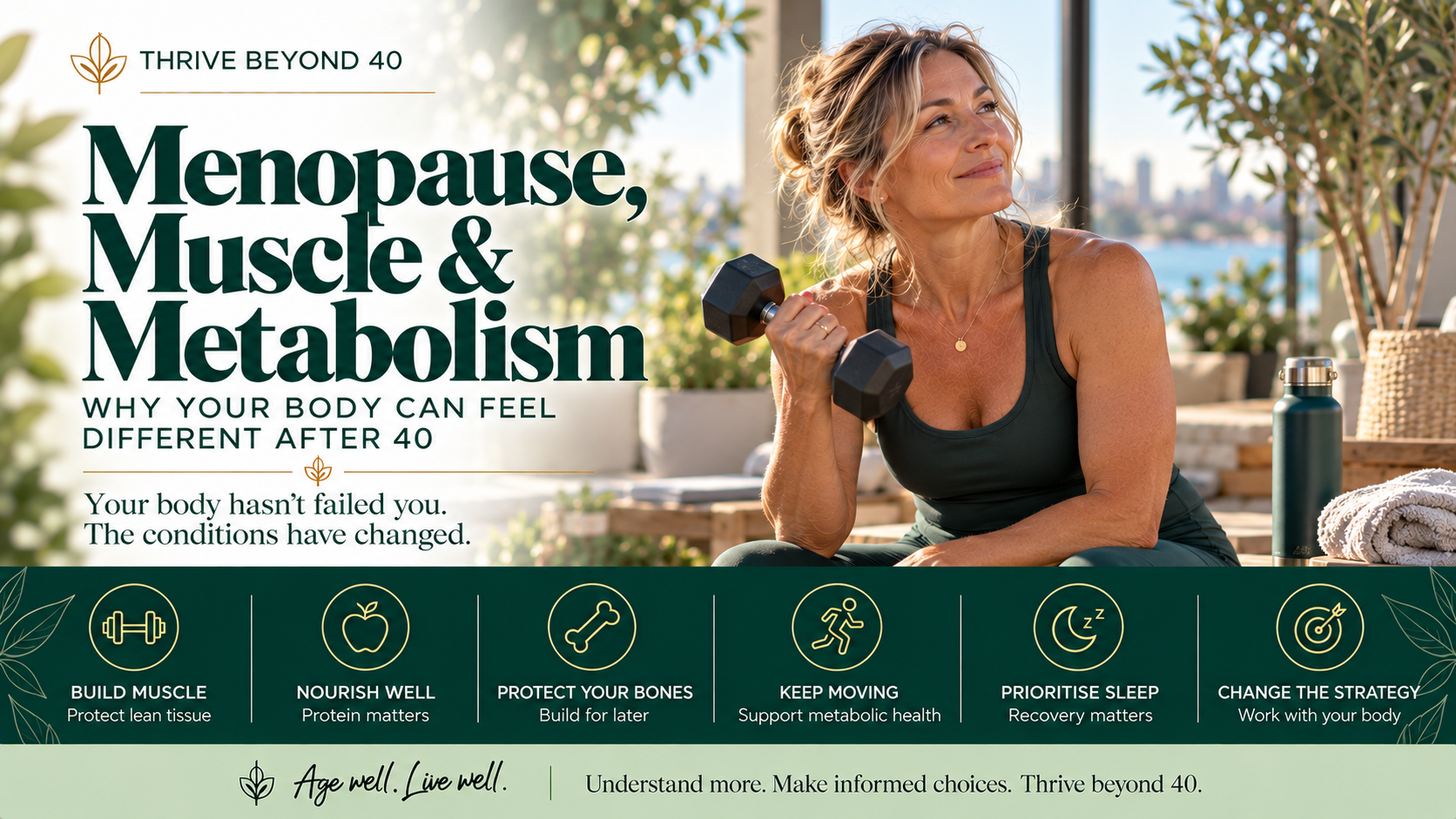
Your body hasn't failed you. The conditions have changed.
There can be a strange moment in your 40s when the things that always seemed to work suddenly don't work quite the same way.
You haven't dramatically changed what you eat.
You're still reasonably active.
Perhaps you're exercising more than you used to.
And yet your body feels different.
Weight seems easier to gain.
Muscle definition is harder to maintain.
Fat appears in places it didn't before.
Sleep becomes unpredictable.
Recovery takes longer.
Energy fluctuates.
And the strategy that once worked whenever you wanted to "get back into shape" doesn't seem nearly as effective.
For many women, this happens around the same time as perimenopause.
It's easy to look in the mirror and think:
"What am I doing wrong?"
But your body hasn't failed you.
The conditions have changed.
And understanding those changes can help you build a much smarter strategy for the years ahead.
Perimenopause is more than hot flushes
When we talk about perimenopause, the conversation often focuses on symptoms.
Hot flushes.
Night sweats.
Irregular periods.
Mood changes.
Brain fog.
Sleep disruption.
All important.
But the menopausal transition can also coincide with changes in body composition, muscle, bone and where fat tends to be stored.
At the same time, we're getting older.
Work may be more demanding.
Family responsibilities may be significant.
Sleep may be worse.
Movement can decrease.
Stress can increase.
So when your body starts changing in your 40s, there isn't always one neat explanation.
Ageing and menopause are happening alongside real life.
That's why simplistic advice such as "just eat less and move more" isn't particularly helpful.
Does menopause slow your metabolism?
This is where the conversation needs some nuance.
You'll often hear:
"Menopause destroys your metabolism."
That's too simplistic.
Your metabolism doesn't suddenly switch off when your hormones change.
Ageing itself is associated with changes in body composition and energy expenditure, particularly if we lose metabolically active lean tissue and become less active.
Menopause can add another layer.
Changes in oestrogen appear to influence body-fat distribution, with women often experiencing a greater tendency to accumulate fat around the abdomen through the menopausal transition.
Sleep disruption, stress, activity levels, appetite, dietary habits and muscle mass can all contribute too.
So yes, your body may behave differently.
But that doesn't mean your metabolism is broken.
And it certainly doesn't mean there's nothing you can do.
Muscle becomes increasingly valuable
If there is one thing I want women to take more seriously after 40, it's muscle.
Not because everyone needs sculpted arms or visible abs.
Because muscle is part of your healthy-ageing infrastructure.
It helps you:
Move.
Lift.
Carry.
Climb.
Exercise.
Maintain physical capability.
Support metabolic health.
And remain independent later in life.
Age-related muscle loss becomes increasingly relevant as we get older, particularly if we're not doing anything to challenge and maintain our muscles.
Muscle is something worth protecting before you notice you've lost it.
The scale doesn't tell you enough
This is another reason I don't want women becoming fixated on body weight alone.
Imagine two women who both weigh 70 kilograms.
One has more muscle and less body fat.
The other has less muscle and more body fat.
The scale gives them exactly the same number.
Their body composition is different.
That's why healthy ageing can't simply become a lifelong attempt to make the number on the scales smaller.
The goal isn't necessarily to weigh less.
The goal may be to become stronger, improve body composition and protect lean tissue.
That can change the way you think about progress completely.
Stop trying to shrink yourself
Many women grew up in an era where health advice was essentially:
Eat less.
Choose low-fat everything.
Do more cardio.
Make yourself smaller.
Then repeat.
But the body you need in your 50s, 60s and 70s requires resources.
Protein.
Muscle.
Bone.
Energy.
Strength.
Recovery.
Healthy ageing isn't about taking up as little space as possible.
It's about building a body capable of carrying you through the life ahead.
That is a very different goal.
Strength training changes the conversation
Cardiovascular exercise is important.
Walking is wonderful.
Running, cycling and swimming can all be fantastic.
But women also need resistance training in the conversation.
Weights.
Machines.
Resistance bands.
Body-weight exercises.
Whatever allows you to challenge your muscles progressively and appropriately.
Australian physical activity guidelines recommend adults include muscle-strengthening activities on at least two days each week.
And I think that's an incredibly useful baseline.
You don't need to become a bodybuilder.
You don't need to spend every evening in a gym.
You need to give your muscles a reason to stay.
Strength is about much more than appearance
Yes, building muscle can change how your body looks.
And it's completely okay to care about that.
But strength also supports the things we may value even more as we age.
Carrying luggage.
Getting off the floor.
Lifting children or grandchildren.
Moving furniture.
Hiking.
Travelling.
Gardening.
Playing sport.
Maintaining balance.
Living independently.
Strength is freedom expressed physically.
That's why our Strength After 40 article calls muscle one of your best investments in healthy ageing.
Because the return isn't just visible.
It's functional.
Protein becomes part of the strategy
If you're strength training but not giving your body the nutritional building blocks it needs, you're missing part of the picture.
Protein provides amino acids used throughout the body and contributes to the growth and maintenance of muscle mass.
After 40, I think women need to stop viewing protein as something only gym people talk about.
It's healthy-ageing nutrition.
Think:
Eggs.
Greek yoghurt.
Fish.
Chicken.
Lean meat.
Tofu.
Tempeh.
Legumes.
Cottage cheese.
Milk.
Soy foods.
And other protein-rich foods you enjoy.
The goal isn't to eat enormous amounts of protein.
It's to make protein intentional.
Our next Thrive Journal article will explore Protein After 40 properly, including how much we may need and how to distribute it through the day.
Breakfast is worth looking at
This is one of the easiest places to notice a protein gap.
Toast and coffee.
Cereal.
A piece of fruit.
Perhaps nothing at all.
Then most of the day's protein arrives at dinner.
For some people, that's simply habit.
But spreading protein-rich foods across the day can make it easier to achieve an adequate overall intake and provide repeated opportunities for muscle protein synthesis.
That might mean:
Greek yoghurt and fruit.
Eggs with wholegrain toast.
A smoothie containing a meaningful protein source.
Cottage cheese.
Leftovers.
Or whatever works for your lifestyle.
Don't diet away the muscle you're trying to protect
This is particularly important when weight loss is a goal.
It's completely reasonable to want to lose excess body fat.
Healthy weight loss can improve health for many people.
But aggressive dieting can create problems.
If energy intake becomes too low and protein and resistance training aren't prioritised, some of the weight you lose can be lean tissue.
And after 40, muscle isn't something I want us casually sacrificing in pursuit of a smaller number.
A better goal is often:
Lose fat while protecting muscle.
That means taking a more considered approach to nutrition, protein and strength training.
Your bones are part of this conversation too
Muscle and bone aren't separate healthy-ageing projects.
They work together.
Resistance and appropriate weight-bearing exercise provide mechanical loading that can help support bone health.
And this becomes especially important for women because bone loss can accelerate around menopause as oestrogen declines.
That's why we've created an entire Thrive Journal article on Bone Health After 40.
Your future body needs both.
Strong muscles.
Strong bones.
Capability is built on both.
Sleep can change everything
Now imagine trying to do all of this while sleeping badly.
Night sweats.
Early waking.
Difficulty falling asleep.
Restless sleep.
Stress.
A busy mind at 3 am.
Then the alarm goes off.
You're tired.
Exercise feels harder.
Food choices become more difficult.
You reach for caffeine.
Recovery suffers.
Perhaps you're hungrier.
Then someone tells you that all you need is more discipline.
That's not particularly useful.
Sleep isn't an optional extra in a body-composition strategy.
It's part of the environment in which your body is trying to function.
If sleep has become persistently difficult during perimenopause, don't simply accept it as something you have to endure.
Discuss your symptoms and treatment options with an appropriately qualified healthcare professional.
Menopausal hormone therapy belongs in an informed conversation
Nutrition and exercise are incredibly important.
But they don't replace medical care.
Menopausal hormone therapy, often called MHT, is an established treatment option for menopausal symptoms and may have other health considerations depending on the individual.
Whether it's appropriate for you depends on your symptoms, medical history, risks and preferences.
That's a conversation to have with your GP or menopause-informed healthcare professional.
Thrive Beyond 40 isn't here to replace that conversation.
We're here to help build the broader health foundations around it.
Strength.
Nutrition.
Sleep.
Heart health.
Bone health.
Healthy body composition.
Recovery.
And understanding your body.
What about belly fat?
This is one of the questions women often really want answered.
"Why is my stomach changing?"
Changes in fat distribution around menopause are real.
Women may notice more fat accumulating centrally around the abdomen, even if their overall weight hasn't changed dramatically.
But abdominal fat isn't simply a cosmetic concern.
Greater central or visceral fat is associated with metabolic and cardiovascular risk.
That doesn't mean panicking about your waistline.
It means broadening the conversation beyond appearance.
Body composition is health information too.
Strength training.
Regular movement.
Appropriate nutrition.
Sleep.
Healthy weight management where needed.
And understanding cardiovascular and metabolic risk factors all belong in the strategy.
Know the health numbers that actually matter
If your body is changing after 40, don't only watch the bathroom scales.
There are other numbers worth understanding.
Blood pressure.
Blood lipids.
Blood glucose where appropriate.
Waist circumference can sometimes provide useful context around central adiposity.
And depending on your age and individual circumstances, other preventive checks may be relevant too.
Talk to your GP about what is appropriate for you.
Don't measure everything.
Measure what helps you make better decisions.
Omega-3 belongs in the nutritional foundation
We also pay attention to fatty-acid nutrition at Thrive Beyond 40.
The long-chain omega-3 fatty acids EPA and DHA have established physiological roles, including contributing to normal heart function at appropriate intakes.
DHA also contributes to normal brain function.
Good food sources include oily fish such as salmon, sardines, mackerel and trout.
Within our Balance Program, we take a personalised approach through at-home fatty-acid testing, targeted nutritional support and retesting.
Not because omega-3 is a menopause cure.
It isn't.
Because healthy ageing is built from multiple foundations.
And fatty-acid nutrition is one of them.
Your metabolism needs movement, not punishment
If your body changes, the instinct can be:
Train harder.
Eat less.
Add more cardio.
Punish the weight off.
I'd rather see a different approach.
Build muscle.
Move regularly.
Eat enough protein.
Nourish yourself.
Sleep.
Recover.
Create an appropriate energy balance if fat loss is your goal.
Give it time.
You don't need to fight your body.
You need to work with the physiology you have now.
Recovery becomes part of training
At 25, perhaps you could sleep badly, train hard and somehow feel fine.
At 45 or 50, your body may be less forgiving.
That doesn't mean you need to stop challenging yourself.
It means recovery deserves more respect.
Hard training creates a stimulus.
Recovery is where adaptation happens.
So build easier days into your week.
Sleep.
Eat.
Hydrate.
Walk.
Stretch if you enjoy it.
Take rest days.
And listen when persistent pain or exhaustion is telling you something needs attention.
More isn't always better.
Better is better.
Don't confuse different with worse
This may be the most important part.
Your body at 45 isn't supposed to be identical to your body at 25.
You're not failing because your physiology has changed.
You're living through a normal stage of life.
And there can be enormous freedom in stopping the fight against that reality.
You can still become stronger.
Fitter.
Healthier.
More capable.
Better nourished.
More confident.
Perhaps even more comfortable in your body than you've ever been.
Different doesn't mean finished.
It means the strategy evolves.
Build the body you're taking into the next chapter
Imagine yourself 20 years from now.
You're not thinking about whether you fitted into the jeans you wore at 28.
You're thinking about whether you can:
Travel.
Walk all day.
Carry your bags.
Get up from the ground.
Play with grandchildren.
Go to the gym.
Swim.
Hike.
Dance.
Work if you choose.
Live independently.
Enjoy yourself.
That's why I want women thinking about muscle and metabolism differently.
We're not trying to recreate our younger bodies.
We're building capable older ones.
Start with strength.
Nourish your muscles.
Protect your bones.
Support your heart.
Prioritise sleep.
Understand your changing body.
Seek appropriate medical support.
And stop treating every physical change as evidence that you've done something wrong.
Your body hasn't failed you.
The conditions have changed.
So change the strategy.
Build strength.
Nourish well.
Understand your body.
Invest in what's next.
Health is the foundation. Life is the point.
Age Well. Live Well.
Ready to build for what comes next?
Your body is changing. Your strategy can too.
Thrive Beyond 40 takes a broader approach to healthy ageing through evidence-informed education, personalised insight, targeted nutrition and sustainable health foundations.
Not chasing your younger body.
Building a strong, capable one for the years ahead.
Continue exploring
Perimenopause and Healthy Ageing: Looking Beyond the Symptoms →
Strength After 40: Why Muscle Is One of Your Best Investments in Healthy Ageing →
Bone Health After 40: Why Strong Bones Need Attention Before You Feel a Problem →
Sleep After 40: Why Recovery Matters More Than You Think →
Keywords: perimenopause metabolism, menopause metabolism, muscle after menopause, body composition menopause, weight gain perimenopause, strength training menopause, protein menopause, belly fat menopause, healthy ageing women, women’s health after 40
Category: Women's Health